
Published: 06/24/2026
Share this article

Ambulatory healthcare organizations are under increasing pressure to do more with the resources they have. Patient demand continues to grow, reimbursement pressures remain significant, staffing challenges persist, and leadership teams are expected to improve both access to care and operational performance simultaneously.
When patient throughput begins to decline, many organizations immediately assume they have a staffing problem. Others blame their EHR. While staffing shortages and technology limitations can certainly contribute to operational challenges, one of the most common root causes is often hidden in plain sight: workflow inefficiency.
Electronic Health Records support nearly every operational and clinical function within an ambulatory clinic. Scheduling, registration, patient intake, clinical documentation, orders management, referrals, and revenue cycle activities all depend on workflows functioning efficiently. When bottlenecks emerge, they can slow patient movement through the clinic, reduce provider productivity, increase administrative burden, and ultimately affect both patient satisfaction and financial performance.
The challenge is that workflow bottlenecks rarely appear overnight. They develop gradually as organizations grow, processes evolve, staff responsibilities change, and workarounds become normalized. By the time leadership notices declining productivity or increasing patient wait times, the underlying workflow issues may have existed for months or even years.
The good news is that workflow bottlenecks typically leave measurable indicators long before they become major operational problems. Healthcare leaders who understand where to look can identify inefficiencies early and take corrective action before patient access, provider satisfaction, and organizational performance begin to suffer.
Table of Contents
Hide
- 1. Quick Answer
- 2. What Are EHR Workflow Bottlenecks and Why Do They Matter?
- 3. What Are the Most Common EHR Workflow Bottlenecks in Ambulatory Clinics?
- 4. What Warning Signs Indicate Workflow Bottlenecks Are Affecting Patient Throughput?
- 5. How Can Ambulatory Clinics Systematically Identify Workflow Bottlenecks?
- 6. Which Metrics Should Healthcare Leaders Monitor to Detect Workflow Inefficiencies?
- 7. How Do Workflow Bottlenecks Affect Provider Productivity and Patient Experience?
- 8. When Should Ambulatory Clinics Evaluate Workflow Optimization Support?
- 9. Consultant Perspective
- 10. Leadership Workflow Assessment Checklist
- 11. Conclusion
- 12. Related Articles
- 13. Further Reading
- 14. Fequently Asked Questions
- 15. Not Sure Where to Start?
Quick Answer
Ambulatory clinics can identify EHR workflow bottlenecks by monitoring patient throughput, provider documentation time, scheduling delays, chart completion rates, task queue backlogs, patient wait times, and staff workflow patterns.
Common warning signs include increasing after-hours charting, declining provider productivity, growing operational costs, and reduced appointment availability. By combining workflow observation, performance metric analysis, and staff feedback, healthcare leaders can identify process breakdowns early and improve operational efficiency before patient access and financial performance are negatively impacted.
What Are EHR Workflow Bottlenecks and Why Do They Matter?
A workflow bottleneck occurs whenever a task, process, or decision point slows the movement of work through an organization. In ambulatory healthcare environments, bottlenecks can affect patients, providers, clinical staff, administrative teams, and leadership simultaneously.
Some bottlenecks occur directly within the EHR. Others occur in surrounding operational processes that rely on the EHR to function effectively. For example, an inefficient referral process may appear to be an EHR problem when the actual issue stems from unclear staff responsibilities or inconsistent workflows.
Regardless of the source, workflow bottlenecks can have widespread consequences.
When scheduling workflows become inefficient, appointment availability declines. When registration processes slow down, patient wait times increase. When documentation workflows are cumbersome, providers spend more time charting and less time seeing patients. When tasks accumulate in work queues, patient care and revenue cycle activities can be delayed.
Over time, these inefficiencies directly affect organizational priorities such as:
- Financial performance
- Access to care
- Provider productivity
- Patient satisfaction
- Employee retention
- Organizational growth
Healthcare leaders often discover that the issues they initially attributed to staffing shortages or technology limitations are actually symptoms of workflow processes that have never been formally evaluated. In many cases, organizations benefit from evaluating whether EHR configuration, documentation workflows, and system design are contributing to operational inefficiencies that affect patient throughput.
What Are the Most Common EHR Workflow Bottlenecks in Ambulatory Clinics?
What Are the Most Common EHR Workflow Bottlenecks in Ambulatory Clinics?
Scheduling Workflows
Scheduling represents the first operational touchpoint in the patient journey. When scheduling workflows become inefficient, the effects can be felt throughout the organization.
Common scheduling bottlenecks include:
- Outdated appointment templates
- Inefficient scheduling rules
- Referral management delays
- Excessive manual scheduling activities
- Inconsistent scheduling practices across departments
Even minor scheduling inefficiencies can reduce clinic capacity and create unnecessary delays for patients seeking care.
Registration and Patient Intake
Registration and intake workflows often contain hidden inefficiencies that contribute to downstream operational challenges.
Examples include:
- Duplicate data entry requirements
- Insurance verification delays
- Incomplete patient information
- Manual intake processes
- Poor patient portal adoption
When these issues occur, clinical staff frequently spend valuable time correcting administrative problems that could have been addressed earlier in the patient journey.
Clinical Documentation
Documentation remains one of the largest contributors to workflow inefficiency in ambulatory care.
Organizations commonly struggle with:
- Excessive clicks
- Redundant documentation requirements
- Poorly designed templates
- Inefficient navigation
- Inconsistent documentation standards
As documentation burdens increase, provider productivity often decreases while after-hours charting becomes more common.
Orders and Results Management
Clinical communication workflows can create substantial operational friction when not properly managed.
Common bottlenecks include:
- Delayed order processing
- Task routing errors
- Inbox management challenges
- Communication breakdowns
- Lack of workflow ownership
These issues can delay patient care while increasing administrative workload.
Revenue Cycle Processes
Workflow bottlenecks frequently extend into financial operations.
Examples include:
- Charge capture delays
- Coding bottlenecks
- Documentation deficiencies
- Claim submission delays
- Denial management inefficiencies
In many organizations, revenue cycle challenges originate from workflow problems occurring much earlier in the patient encounter.
One common challenge we see is organizations focusing heavily on provider workflows while overlooking administrative bottlenecks occurring earlier in the patient journey. The most visible problems often occur during patient encounters, but the root causes frequently begin during scheduling, registration, or intake.

What Warning Signs Indicate Workflow Bottlenecks Are Affecting Patient Throughput?
Workflow bottlenecks often reveal themselves through operational indicators long before leadership recognizes a significant problem.
Patient Indicators
Patients typically experience workflow inefficiencies first.
Common indicators include:
- Longer wait times
- Delayed appointments
- Reduced appointment availability
- Increased complaints
- Difficulty accessing care
Patients may not understand the operational causes behind these issues, but they often recognize the impact immediately.
Providers frequently experience the operational burden of inefficient workflows.
Warning signs include:
- Increased documentation time
- More after-hours charting
- Reduced patient-facing time
- Lower productivity
- Increased burnout risk
When providers spend more time managing administrative tasks than caring for patients, workflow evaluation should become a leadership priority. This is particularly important as documentation burden and administrative complexity continue to be recognized as significant contributors to provider burnout and reduced productivity.
Staff Indicators
Administrative and clinical support staff often provide valuable insight into workflow performance.
Potential indicators include:
- Increased overtime
- Growing task queues
- Delayed task completion
- Rising frustration levels
- Increased turnover
These symptoms often signal that operational processes are no longer functioning efficiently.
Executive Indicators
Lorem ipsum dolor sit amet, consectetur adipiscing elit, sed do eiusmod tempor incididunt ut labore et dolore magna
Leadership teams should monitor organization-wide performance indicators.
Examples include:
- Declining productivity metrics
- Throughput stagnation
- Rising operational costs
- Reduced financial performance
- Lower patient satisfaction scores
Organizations experiencing multiple indicators simultaneously should strongly consider a formal workflow evaluation.
How Can Ambulatory Clinics Systematically Identify Workflow Bottlenecks?
Identifying workflow bottlenecks requires more than reviewing reports. Successful evaluations combine operational data with direct observation and stakeholder feedback.
Step 1: Map the Patient Journey
Begin by documenting the complete patient experience.
Evaluate workflows related to:
- Scheduling
- Registration
- Rooming
- Provider encounters
- Documentation
- Billing
Understanding how work moves through the organization helps identify where delays occur.
Step 2: Observe Workflow Activity
Direct observation often reveals issues that are invisible in performance reports.
Look for:
- Waiting periods
- Duplicate work
- Manual processes
- Excessive handoffs
- Unnecessary approvals
Many organizations are surprised by the amount of time lost through small inefficiencies that have become accepted as normal operations.
Step 3: Measure Operational Performance
Operational data helps quantify workflow performance.
Review metrics such as:
- Patient throughput
- Documentation completion time
- Task completion rates
- Wait times
- Appointment utilization
- Provider productivity
These metrics provide objective evidence of workflow challenges. Organizations that consistently monitor operational performance are often better positioned to identify inefficiencies early and support ongoing quality improvement initiatives.
Step 4: Validate Findings
Engage stakeholders throughout the organization.
Gather feedback from:
- Providers
- Clinical staff
- Administrative staff
- Department leaders
- Executive leadership
Organizations frequently underestimate the value of direct workflow observation. Data may identify where problems exist, but observation often reveals why they exist.

Which Metrics Should Healthcare Leaders Monitor to Detect Workflow Inefficiencies?
The most effective organizations monitor workflow performance continuously rather than waiting for problems to emerge.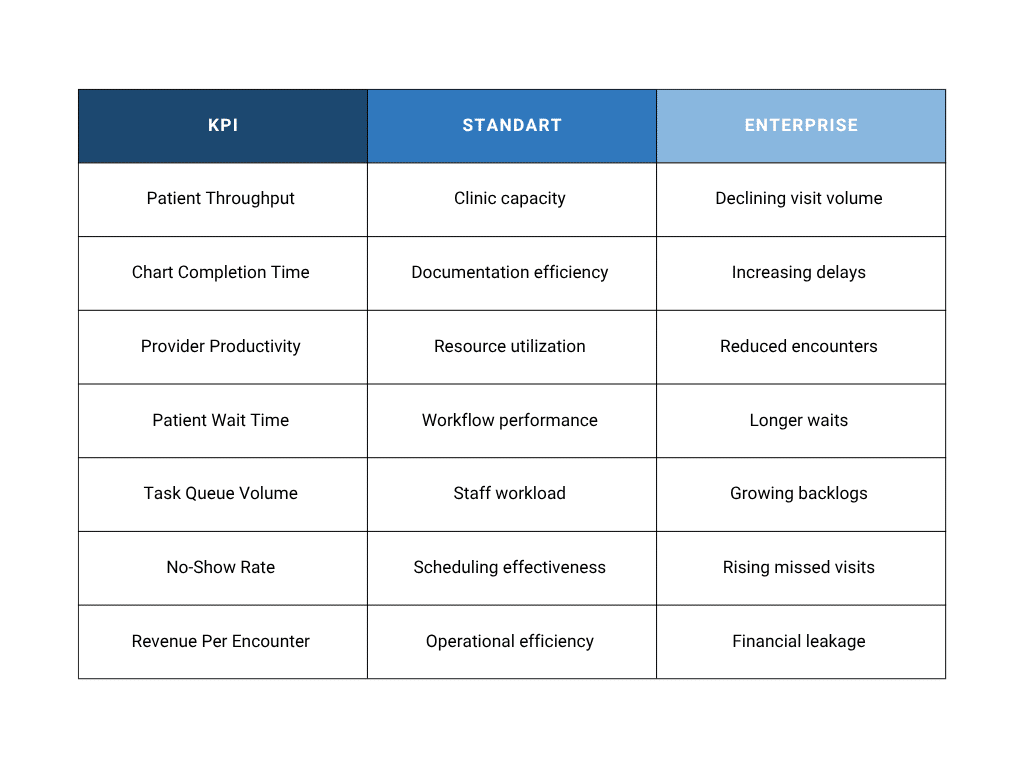 Rather than focusing on isolated data points, leadership teams should evaluate trends over time. Consistent negative movement across multiple metrics often signals a workflow issue requiring further investigation.
How Do Workflow Bottlenecks Affect Provider Productivity and Patient Experience?
Workflow inefficiencies create ripple effects throughout the organization.
For providers, inefficient workflows contribute to increased administrative burden, documentation fatigue, frustration, and burnout. When providers spend excessive time navigating systems or managing tasks, less time is available for patient care.
Patients experience the effects differently. Longer wait times, delayed appointments, reduced access to care, and communication challenges all affect the patient experience. Over time, these issues can influence patient satisfaction and retention.
Organizations feel the impact through reduced efficiency, lower throughput, increased labor costs, revenue leakage, and staff turnover.
Healthcare organizations often focus on staffing solutions when operational workflow redesign may address the underlying issue more effectively. In many cases, improving workflow efficiency allows organizations to increase capacity without adding additional staff.
When Should Ambulatory Clinics Evaluate Workflow Optimization Support?
Many organizations wait too long before formally evaluating workflow performance.
Healthcare leaders should consider workflow optimization support when they observe:
- Declining Provider Productivity
Providers are spending more time documenting and seeing fewer patients.
- Documentation Delays
Unsigned charts and documentation backlogs continue to increase.
- Throughput Reductions
Patient demand remains strong, but fewer patients are being seen.
- Growing Operational Inefficiencies
Overtime expenses increase while productivity remains stagnant.
- Workflow Visibility Limitations
Leadership lacks reliable workflow data and relies primarily on anecdotal feedback.
Workflow assessments, EHR optimization initiatives, operational reviews, and process improvement projects can help organizations identify root causes and prioritize meaningful improvements before performance declines become more significant.
Consultant Perspective
Across ambulatory healthcare organizations, several themes consistently emerge.
Healthcare leaders often discover that workflow challenges are creating larger operational barriers than technology limitations.
Organizations frequently underestimate the cumulative impact of documentation burden, administrative workflow delays, and hidden productivity losses.
Perhaps most importantly, throughput challenges rarely have a single root cause. Workflow inefficiencies often develop across multiple departments and processes simultaneously.
One common challenge we see is operational decisions being made without measurable workflow visibility. Without objective workflow data, organizations risk treating symptoms rather than addressing underlying causes.
Leadership Workflow Assessment Checklist
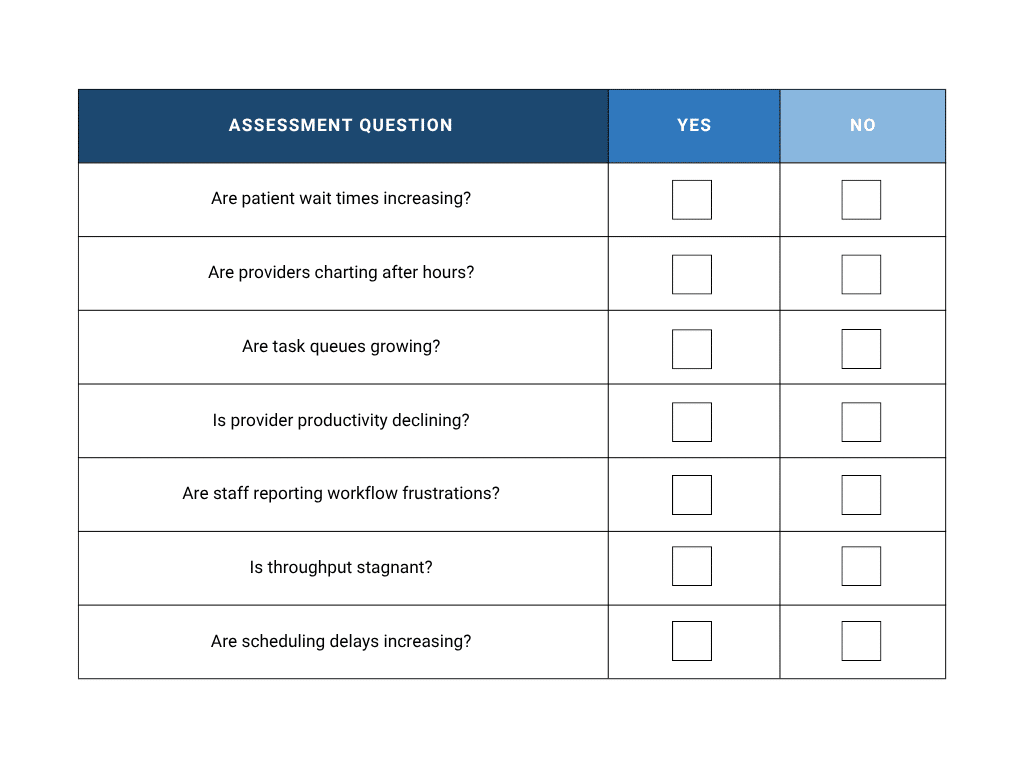
Use the following questions as a high-level assessment of workflow health within your organization.
Assessment Interpretation
0–2 Yes Responses: Low Risk
3–4 Yes Responses: Moderate Risk
5 or More Yes Responses: Consider a formal workflow evaluation to identify underlying operational bottlenecks.
Conclusion
EHR workflow bottlenecks rarely develop suddenly. More often, they emerge gradually as organizations grow and operational processes evolve. Left unaddressed, these inefficiencies can reduce patient throughput, increase provider burden, limit patient access, and negatively affect financial performance.
Healthcare leaders who proactively monitor workflow performance gain valuable visibility into operational challenges before they become significant barriers to growth. By evaluating workflow metrics, observing operational processes, and engaging stakeholders throughout the organization, ambulatory clinics can identify opportunities to improve efficiency, strengthen provider productivity, and enhance the patient experience.
For ambulatory healthcare organizations seeking greater visibility into operational performance, evaluating EHR-enabled workflows can provide valuable insight into opportunities to improve efficiency, increase patient throughput, and support long-term organizational success.
Every ambulatory healthcare organization faces workflow challenges as operations evolve and grow. If you would like an objective assessment of your current workflows, patient throughput processes, or EHR-enabled operations, contact John Lynch & Associates to discuss opportunities to improve efficiency, provider productivity, and patient access.
Fequently Asked Questions
Not all workflow problems originate from the EHR itself. Many stem from workflow design, documentation requirements, staffing processes, or inefficient handoffs. A workflow assessment can help determine whether the issue is technology-related, process-related, or both.

Not Sure Where to Start?
Whether you're preparing to launch a new healthcare organization, addressing compliance concerns, improving operational performance, evaluating technology investments, or looking to strengthen workflows, the right assessment can help identify risks, uncover opportunities, and prioritize next steps.