
Published: 12/10/2025
Share this article
A value-based healthcare IT strategy is no longer optional. As care models shift toward outcomes-driven reimbursement, healthcare organizations must align technology decisions with clinical, financial, and operational goals. For ambulatory providers in particular, the right IT strategy enables sustainable growth, smarter resource use, and improved patient care, all while navigating regulatory complexity and market pressure.
This Insight explores how to design a healthcare IT strategy that supports value-based care at every level. From infrastructure and compliance to EHR optimization and performance tracking, we offer practical steps and strategic clarity to help you plan, invest, and lead with purpose.
Article Highlights
- A value-based IT strategy connects technology investments to measurable clinical, financial, and operational outcomes
- EHR optimization, data governance, and secure interoperability are core to scaling impact across ambulatory organizations
- Clear KPIs and real-time analytics create the foundation for continuous improvement and long-term success
Table of Contents
Hide
- 1. Article Highlights
- 2. What Is a Value-Based Healthcare IT Strategy?
- 3. Why a Value-Based Healthcare IT Strategy Matters for Ambulatory Providers
- 4. Key Components of a Value-Based Healthcare IT Strategy
- 5. Building the Roadmap for Your Healthcare IT Strategy
- 6. Compliance and Security in a Value-Based Healthcare IT Strategy
- 7. Scaling Your Healthcare IT Strategy Across Teams and Locations
- 8. Measuring the Success of Your Healthcare IT Strategy
- 9. Leading with Strategy, Investing with Purpose
- 10. Ready to Talk?
- 11. Further Reading
- 12. Related Articles
What Is a Value-Based Healthcare IT Strategy?
Connecting Healthcare IT Strategy to Value-Based Care Goals
A value-based healthcare IT strategy aligns technology with improved outcomes, efficiency, and accountability. It connects every IT decision to performance measures, care quality, and patient engagement.
Technology plays a central role in enabling this shift. Real-time reporting dashboards, integrated care coordination tools, and population health analytics allow ambulatory providers to track outcomes, close care gaps, and deliver smarter interventions. These capabilities are essential for meeting the demands of value-based contracts and payer expectations.
In ambulatory settings, we’ve seen IT strategies succeed when they focus on reducing fragmentation across systems, empowering care teams with accessible data, and supporting workflows that prioritize prevention and continuity. A value-based IT strategy is coordinated, outcome-focused, and built to adapt over time.
Why a Value-Based Healthcare IT Strategy Matters for Ambulatory Providers
Value-based care demands more than clinical performance. It requires a cohesive, data-informed infrastructure that supports measurable improvement. For ambulatory providers, a strong healthcare IT strategy ensures that technology investments actively support patient care, streamline operations, and position the organization to thrive under evolving payment models.
A well-executed IT strategy reduces duplication and inefficiency by integrating systems and automating routine tasks. This opens up capacity for providers to focus on delivering high-quality care. When clinical workflows are supported by intuitive EHR systems, care teams are better able to meet quality benchmarks, track performance, and address patient needs in real time.
Technology also enhances patient engagement, which is critical in value-based care. Patient portals, remote monitoring tools, and secure messaging platforms improve communication, adherence, and satisfaction. When these tools are aligned with your strategy, they contribute directly to improved outcomes and reduced costs.
One of the most impactful steps ambulatory organizations can take is optimizing their EHR systems to support this shift. Our team has helped clinics reconfigure EHR workflows to better capture quality metrics, support clinical decision-making, and automate reporting tied to payer contracts. These changes improve compliance and care delivery.
To explore how EHR optimization directly contributes to strategic outcomes, we recommend reviewing The Power of EHR Optimization in Ambulatory Care
Key Components of a Value-Based Healthcare IT Strategy
A value-based healthcare IT strategy relies on three essential components. Each one helps drive measurable outcomes and supports long-term growth.
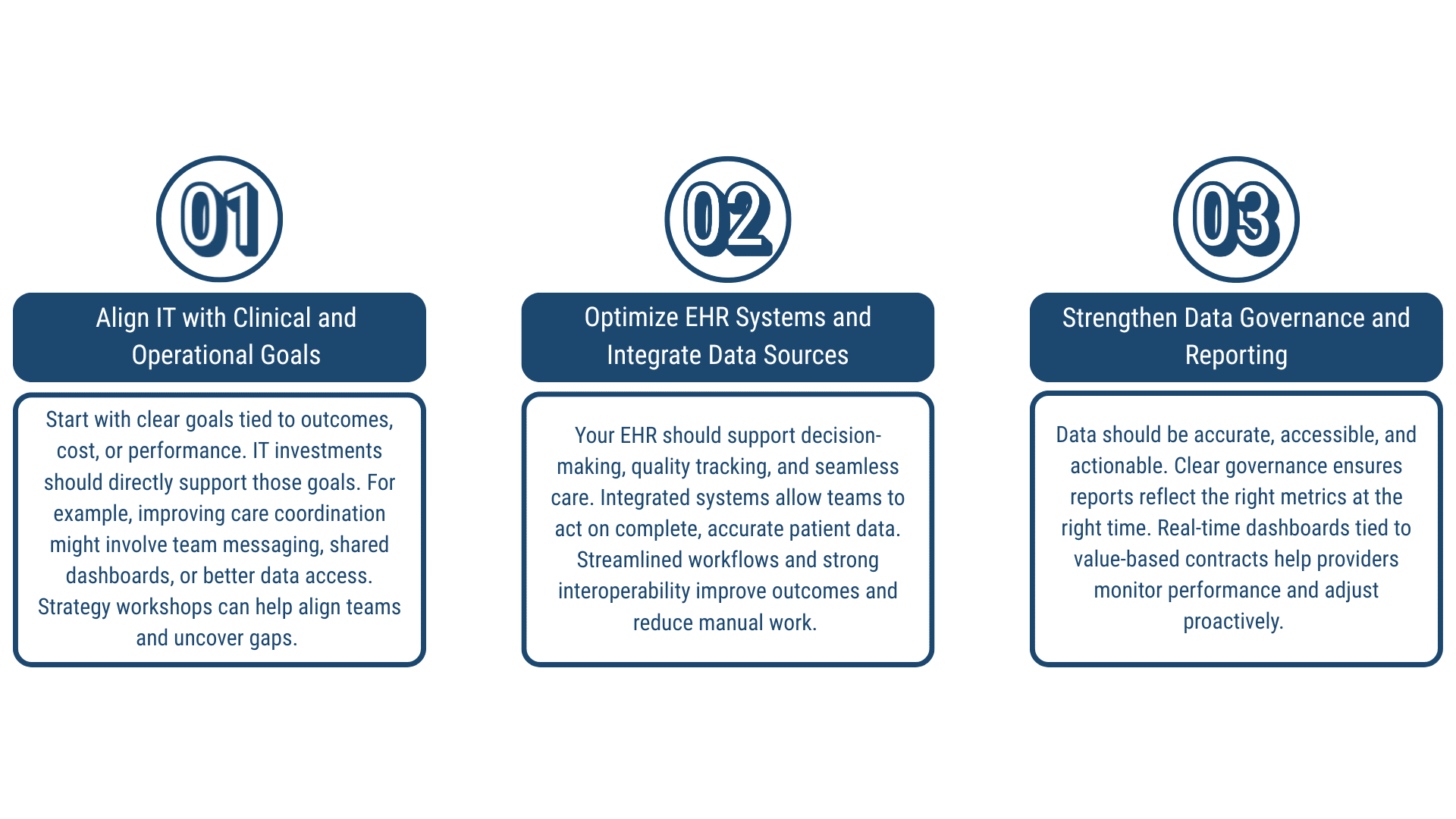
To learn more about national interoperability efforts that support value-based care, visit ONC Trusted Exchange Framework and Common Agreement (TEFCA)
Building the Roadmap for Your Healthcare IT Strategy
Every successful healthcare IT strategy needs a clear, actionable roadmap. This roadmap provides structure for decision-making, budgeting, and implementation while keeping the focus on long-term outcomes. For ambulatory organizations working within value-based models, a strategic roadmap helps connect daily operations to broader goals like population health, quality improvement, and financial sustainability.
IT Assessment and Gap Analysis
The first step in building your roadmap is understanding where you stand today. A full IT assessment allows you to evaluate your current systems, infrastructure, and security posture. This includes reviewing your EHR capabilities, reporting tools, workflows, and integrations. Once you’ve identified strengths and weaknesses, a gap analysis reveals what’s missing and where improvements are most needed. Whether the issue is inefficient documentation, limited data access, or underutilized tools, a clear picture of your current state helps prioritize what to address first.
Prioritizing Investments Based on Value Outcomes
After identifying your gaps, the next step is prioritizing IT investments that deliver measurable value. Focus on technology that supports specific care goals, such as chronic disease management, patient engagement, or real-time reporting. Consider both operational and capital expenses, balancing short-term wins with long-term gains. The most successful organizations use their value-based performance measures to guide IT decisions, ensuring every dollar contributes to clinical improvement, operational efficiency, or regulatory compliance.
To explore more about aligning IT planning with long-term organizational strategy, visit HIMSS: Strategic Health IT Planning
Compliance and Security in a Value-Based Healthcare IT Strategy
In value-based care, technology cannot drive improvement unless it is secure, compliant, and reliable. As organizations adopt more digital tools, the need for a strong compliance and cybersecurity foundation becomes critical. A thoughtful healthcare IT strategy must protect patient information, meet regulatory expectations, and reduce risk at every level.
HIPAA Compliance as a Foundation
HIPAA requirements are central to building trust and maintaining operational integrity in value-based care environments. A compliant IT strategy ensures that patient data is protected, shared appropriately, and accessible only to authorized users. This includes role-based access, audit controls, secure transmission protocols, and documented risk assessments.
Security and compliance planning should not be reactive. Instead, they should be integrated into your broader IT roadmap. Regular reviews, team training, and structured documentation are key. For guidance on how to apply HIPAA standards to a modern clinical IT environment, the U.S. Department of Health and Human Services offers clear direction through its official HIPAA Security Rule Guidance.
Cybersecurity and Patient Trust
In digital healthcare environments, patient trust is directly linked to data security. As organizations expand their use of cloud services, mobile tools, and remote care platforms, the risks of breaches and cyberattacks grow. A value-based healthcare IT strategy must prioritize cybersecurity from the beginning. Not as an add-on, but as a core strategic layer.
This includes secure system configurations, endpoint protection, encrypted storage, and consistent monitoring. Patients and partners expect data to be protected at all times. Strong cybersecurity is not only essential for compliance but also critical for long-term credibility. For a deeper look at common vulnerabilities and practical steps to strengthen safeguards, we explore this topic further in HIPAA Compliance: 3 Key Areas for Healthcare Offices.

Scaling Your Healthcare IT Strategy Across Teams and Locations
A value-based healthcare IT strategy must be flexible enough to scale across different departments, teams, and care settings without losing consistency or focus. As ambulatory organizations grow or add new service lines, expanding IT infrastructure in a controlled and strategic way becomes essential. Whether managing multi-site operations or expanding into new specialties, leadership must ensure that systems, data, and workflows stay aligned.
IT Governance and Change Management
Strong IT governance sets the tone for successful expansion. Leadership structure, communication pathways, and decision-making frameworks all shape how effectively an IT strategy is carried out across the organization. Without clear ownership and accountability, even the best plans can stall or become fragmented.
Change management plays a central role in scaling your strategy. Teams need clear communication, training, and support to adapt to new tools or processes. Building buy-in at every level, from executive leadership to front-line staff, helps reduce resistance and ensures that the strategy is not only implemented but sustained.
Extending Your Healthcare IT Strategy Across Clinics and Care Settings
Scaling a healthcare IT strategy across multiple sites or specialties requires balance. Systems need to be standardized enough to ensure data consistency and regulatory compliance, while remaining flexible enough to meet the specific needs of each location. A one-size-fits-all approach rarely works in dynamic care environments.
Key challenges often include limited staffing, inconsistent infrastructure, and gaps in data interoperability. These issues can slow progress and increase risk if not addressed early. A strong strategy accounts for these challenges with phased rollouts, modular systems, and centralized oversight. The goal is to create a unified IT environment that supports coordinated care, reliable reporting, and scalable growth.
Measuring the Success of Your Healthcare IT Strategy
A well-designed healthcare IT strategy should not only be implemented effectively but also measured consistently. Success in a value-based environment depends on more than just technology adoption. It requires clear metrics, ongoing evaluation, and a culture of improvement across the organization. By tracking performance and adjusting along the way, leaders can ensure their IT investments are driving real results.
Metrics that Matter in Value-Based IT
To measure the impact of your healthcare IT strategy, focus on metrics that reflect value-based priorities. Clinical outcomes, operational cost reductions, patient satisfaction, and regulatory compliance are key performance areas that connect directly to both care quality and reimbursement.
Selecting the right key performance indicators requires a deep understanding of your organizational goals. For example, if your strategy is designed to reduce readmissions, you’ll want to track follow-up appointment rates, care coordination activity, and readmission trends over time. Aligning IT metrics with business and clinical objectives keeps your teams focused and supports transparency at every level.
Continuous Improvement Through Data
Measuring success is not a one-time task. It is an ongoing process of learning, adapting, and improving. Dashboards and performance reports should be integrated into daily operations so that staff and leadership can monitor trends in real time.
Quality tracking tools help identify which initiatives are working and where adjustments are needed. Adaptive planning means using what the data reveals to inform future investments, workflow refinements, and team training. Feedback loops between IT teams, clinical staff, and executives create a cycle of continuous improvement that keeps your healthcare IT strategy aligned with evolving value-based goals.

Leading with Strategy, Investing with Purpose
A value-based healthcare IT strategy is more than a technology roadmap. It is a leadership tool that connects your vision for patient care with the systems that support it. For ambulatory organizations navigating limited resources, evolving regulations, and performance-based reimbursement, strategic IT planning is essential for long-term success.
The most effective strategies are built around clear goals, measured outcomes, and cross-functional collaboration. They align IT investments with clinical priorities, support secure and compliant operations, and create a foundation for continuous improvement. By leading with purpose and investing with clarity, healthcare leaders can turn technology into a driver of both care quality and operational excellence.
If your organization is ready to build or refine a healthcare IT strategy that aligns with value-based care, we’re here to help. Connect with the team at John Lynch & Associates to start a conversation about your goals, challenges, and opportunities. Together, we can turn strategy into measurable impact.
Ready to Talk?
We partner with forward-thinking healthcare leaders to shape the future. By understanding your goals, we build strategies that improve operations, exceed financial targets, and elevate patient care. Contact us to get started!
Contact us
Further Reading
-
John Lynch & Associates: HIPAA Compliance: 3 Key Areas for Healthcare Offices
A practical tool to help assess compliance strengths and vulnerabilities across key operational areas. -
John Lynch & Associates: Transforming Ambulatory Care: The Power of EHR Optimization
A practical tool to help improve workflows, documentation quality, and patient care through EHR optimization. -
HIMSS: Strategic Health IT Planning
A practical resource providing guidance on developing strategic, long-term health IT roadmaps. -
HHS: HIPAA Security Rule Guidance
A practical resource outlining federal expectations for safeguarding protected health information. -
ONC: Trusted Exchange Framework and Common Agreement (TEFCA)
A practical resource detailing national interoperability standards and trusted data-sharing practices.
Related Articles

Ambulatory Care
December 10, 2025
How to Build a Value-Based Healthcare IT Strategy for Ambulatory Providers
Read article

Tribal Health
July 24, 2025
A Comprehensive Tribal Health IT Strategy for Modern Tribal Health Leaders
Read article

General Healthcare
October 17, 2024
Navigating CIO Vacancies with Interim Leadership
Read article