
Healthcare Compliance Consulting for HIPAA, Program Development, & Ongoing Oversight.

COSTLY PROBLEMS
How Do You Know if Your Healthcare Organization Has Compliance Gaps?
Many healthcare organizations believe they are compliant because policies exist on paper. However, compliance failures often originate from operational breakdowns, inconsistent documentation, weak oversight, or workflows that do not align with regulatory expectations.
In behavioral health environments especially, organizations commonly discover compliance gaps only after:
HIPAA incidents or security concerns
Staff inconsistency
AHCCCS or payer denials
Workflow breakdowns
Documentation deficiencies
Privacy complaints
Licensing reviews
Revenue cycle issues tied to documentation
Audit findings
EXPLAINED
What is Healthcare Compliance and Why it Matters for Healthcare Organizations.
Effective healthcare compliance programs help organizations protect patient data, maintain ethical care standards, prevent fraud and abuse, and reduce the risk of regulatory penalties. Compliance also plays a critical role in maintaining operational stability by ensuring documentation, billing practices, and clinical workflows align with evolving healthcare regulations.
In our experience supporting behavioral health clinics, Tribal Health organizations, and ambulatory practices across the United States, one of the most common compliance gaps is incomplete documentation of medical necessity, which often leads to denied claims and increased audit risk.
CHALLENGES
Behavioral Health Compliance Challenges Healthcare Organizations Commonly Face.
Behavioral health organizations operate in one of the most highly regulated areas of healthcare.
Compliance requirements impact nearly every part of operations including documentation, privacy, staffing oversight, billing, licensing, and patient information management.
PREVENTION
The Financial and Operational Impact of Healthcare Compliance Failures.

Healthcare compliance failures can result in financial penalties, repayment obligations, audit exposure, reputational damage, and significant operational disruption for healthcare organizations. Regulatory enforcement actions, billing violations, privacy breaches, and inadequate compliance oversight can expose organizations to substantial legal and financial risk while disrupting day-to-day operations.
In many healthcare organizations, compliance issues are not identified until they surface through payer audits, denied claims, HIPAA incidents, licensing reviews, or regulatory investigations. By the time these issues are discovered, the financial and operational impact can already be significant.
Federal enforcement agencies, including the Office of Inspector General (OIG), the Department of Health and Human Services (HHS), CMS, and state Medicaid programs regularly investigate compliance failures related to billing practices, patient data security, documentation standards, and federal healthcare program participation.
For behavioral health organizations in Arizona, compliance risks are often intensified by evolving AHCCCS requirements, ADHS licensing expectations, HIPAA obligations, documentation standards, and increasing payer scrutiny. Organizations that lack structured compliance oversight frequently experience operational instability, denied claims, workflow breakdowns, staff inconsistency, and financial performance issues tied directly to documentation and compliance failures.
COMPLIANCE ASSESSMENT
Start with a Healthcare Compliance Assessment
Not sure where your organization is most vulnerable? Many healthcare organizations recognize there may be compliance, operational, documentation, or billing risks, but struggle to identify where the highest-priority gaps actually exist until an audit, denial trend, licensing issue, or operational breakdown forces action.
Our structured healthcare compliance assessments help behavioral health organizations, Tribal Health programs, outpatient clinics, and healthcare leaders proactively identify risks, strengthen compliance readiness, improve operational alignment, and create a clear roadmap for next steps before problems become costly.
Whether you are launching a new behavioral health organization, preparing for Arizona licensing, addressing HIPAA concerns, or improving AHCCCS billing readiness, our assessments are designed to provide practical findings aligned with real-world healthcare operations.

Assessment
Behavioral Health Startup Readiness Assessment
A Behavioral Health Startup Readiness Assessment helps organizations determine whether they are operationally, clinically, financially, and regulatorily prepared for launch or expansion.
Many behavioral health startups face delays, licensing challenges, staffing gaps, workflow breakdowns, or billing issues because critical readiness areas were never fully evaluated before go-live.
This assessment provides leadership with a structured roadmap before expensive mistakes impact timelines, compliance, or financial performance.
Behavioral health founders
- Investors opening behavioral health clinics
Existing organizations expanding services or locations
Arizona outpatient treatment centers
Teams preparing for licensing, payer enrollment, or go-live readiness
Assessment
HIPAA & Compliance Risk Assessment
A HIPAA and Compliance Risk Assessment helps healthcare organizations identify privacy, security, documentation, policy, training, vendor, and oversight gaps that may increase regulatory exposure or operational risk.
Many healthcare organizations have policies in place, but lack consistent implementation, monitoring, training accountability, or operational alignment. These gaps often remain hidden until they surface through audits, investigations, breaches, claim denials, or staff-related compliance failures.
This assessment helps organizations move from uncertainty to a prioritized corrective action strategy focused on reducing risk and strengthening long-term compliance readiness.
Behavioral health organizations
Tribal Health organizations
Ambulatory and outpatient clinics
Organizations preparing for audits
Clinics concerned about HIPAA, policy, training, or documentation gaps
Assessment
Operational & Billing Readiness Review
An Operational & Billing Readiness Review helps healthcare organizations identify workflow, revenue cycle, reporting, EHR, staffing, and accountability gaps that impact reimbursement, operational efficiency, and financial visibility.
Organizations often experience denials, delayed payments, inconsistent workflows, poor reporting visibility, or operational bottlenecks because processes between intake, clinical operations, documentation, and billing are not fully aligned.
This assessment provides operational clarity and identifies the highest-priority improvements needed to strengthen revenue cycle performance and organizational accountability.
Clinics experiencing denials or revenue leakage
Organizations preparing for payer billing
Clinics with unclear intake-to-billing workflows
Teams struggling with EHR reporting visibility
Leaders seeking stronger operational and financial oversight
Healthcare Compliance Services Tailored to Your Organization.
SERVICE
HIPAA Privacy & Security
We provide HIPAA privacy and security consulting to help healthcare organizations identify compliance risks, implement appropriate administrative and technical safeguards, and protect patient health information in accordance with federal privacy and security regulations.
SERVICE
Compliance Program Development
We help healthcare organizations design and implement structured compliance programs that establish policies, procedures, governance oversight, and internal accountability aligned with federal healthcare regulations and OIG compliance guidance.
SERVICE
Staff Training on Regulatory Standards
We provide healthcare compliance training programs that help staff understand HIPAA, HITECH, and other regulatory requirements while strengthening organizational accountability and consistent policy adherence across clinical and administrative teams.
SERVICE
Audit Preparation & Support
We help healthcare organizations prepare for regulatory audits and compliance reviews by strengthening documentation practices, addressing compliance gaps, and supporting leadership teams through audit response and remediation planning.
SERVICE
Ongoing Compliance Monitoring
We provide ongoing compliance monitoring and advisory support to help healthcare organizations track regulatory changes, evaluate internal compliance controls, and maintain continuous alignment with evolving healthcare regulations.
How Our Healthcare Compliance Consulting Process Reduces Risk and Strengthens Operations.

WHY CHOOSE US
Why Healthcare Organizations Choose John Lynch & Associates for Compliance Consulting.
Healthcare compliance requires more than policy creation. Effective compliance programs must integrate with clinical workflows, billing operations, staff accountability, leadership oversight, and evolving regulatory expectations.
John Lynch & Associates brings hands-on healthcare operations and behavioral health experience helping organizations strengthen compliance programs that are practical, sustainable, and operationally aligned. Our approach helps organizations:
Reduce regulatory and audit exposure
Improve HIPAA and documentation compliance
Strengthen operational accountability
Improve billing and payer alignment
Build scalable compliance frameworks
Support long-term operational stability
COMPLIANCE REGULATIONS
Key Healthcare Compliance Regulations Healthcare Organizations Must Navigate.
Healthcare organizations operate within a complex regulatory environment that governs patient privacy, billing practices, data security, and operational oversight. Effective compliance programs must align with multiple federal regulations and regulatory agencies that oversee healthcare delivery and financial practices.
Here are several of the primary regulatory frameworks healthcare organizations must address when building and maintaining a compliant operational environment.
CLIENT SUCCESS
Real-World Results: Healthcare Compliance Transformation.
Results:
- Eliminated critical compliance risks across the organization
- Achieved 100% encryption and multi-factor authentication coverage
- Strengthened staff training and compliance accountability
- Improved vendor oversight and data security practices
Over a five-year period, the organization eliminated critical compliance risks, achieved 100% encryption and multi-factor authentication coverage, and significantly improved training and vendor oversight processes.
Challenge:
Solution:
RESULTS MATTER
Proven Results from Healthcare Compliance Consulting Programs.
Audit Success Rate
Reduction in Compliance Violations
HIPAA Training Completion
Compliance Monitoring Support
Strengthen Your Healthcare Compliance Program.
A strong compliance program protects patients, supports staff, and promotes trust in the care environment. When expectations are unclear or training is inconsistent, risk increases, documentation weakens, and organizational accountability becomes difficult to maintain.
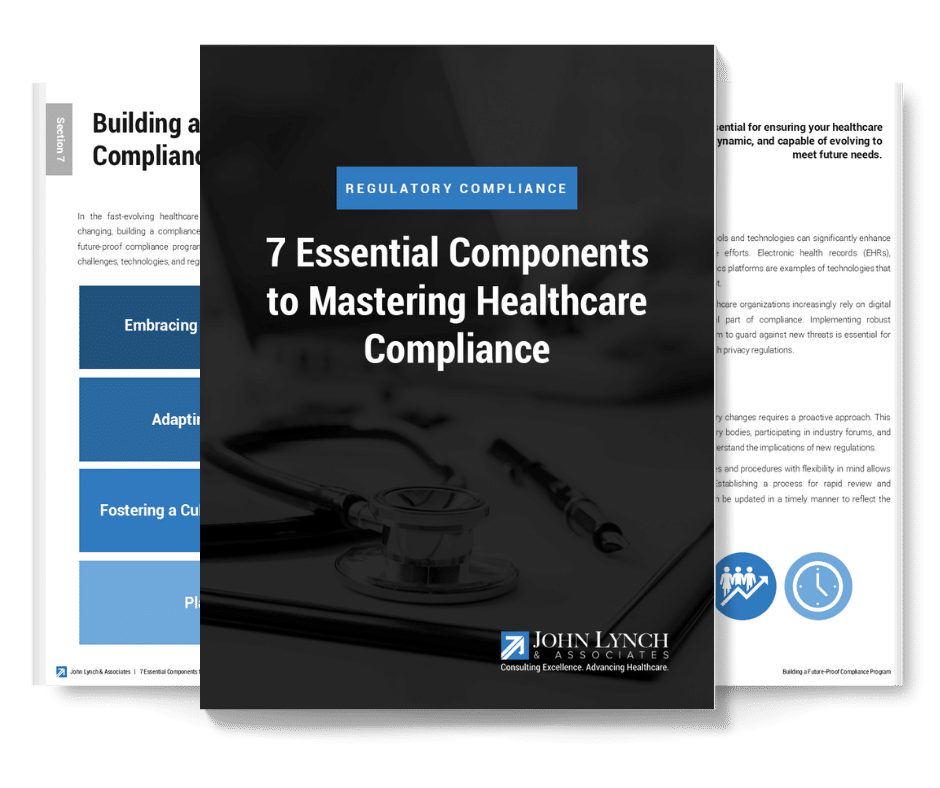
To support your compliance efforts, download the 7 Essential Components to Mastering Healthcare Compliance, which outlines the seven essential components of a successful compliance program and provides a practical structure for improving oversight, engagement, and transparency across the organization.
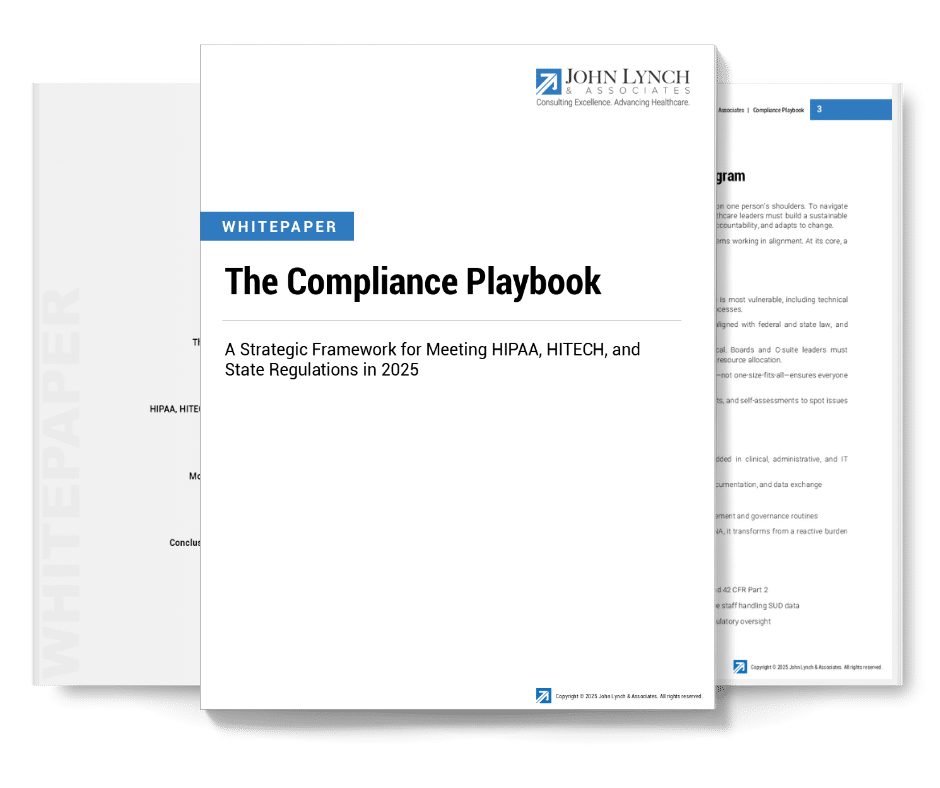
The Compliance Playbook: A Strategic Framework for Healthcare Organizations.
This whitepaper outlines a practical, forward-looking approach to healthcare compliance in 2025, addressing the growing complexity of HIPAA, HITECH, 42 CFR Part 2, and state-specific regulations.
It provides healthcare leaders with guidance on building sustainable compliance programs, embedding compliance into daily operations, preparing teams for audits, and using real-time monitoring to reduce risk.
Designed for tribal health, behavioral health, and ambulatory care organizations, the playbook emphasizes resilience, accountability, and operational readiness in an evolving regulatory landscape.
WE HAVE ANSWERS
Healthcare Compliance FAQs.
Who needs a healthcare compliance program?
What are the three main areas of healthcare compliance?
What is HIPAA compliance in healthcare?
What happens if you fail compliance?
How do healthcare organizations implement an effective compliance program?
Why do healthcare organizations work with compliance consultants?
Healthcare Markets We Specialize In.
Our healthcare compliance consultants support organizations across multiple care environments, each with unique regulatory requirements, operational challenges, and compliance frameworks.
SPECIALIZED EXPERIENCE
Behavioral Health
SPECIALIZED EXPERIENCE
Tribal Health
SPECIALIZED EXPERIENCE
Ambulatory Care
SUPPORT SERVICES
Healthcare Consulting Services that Strengthen Compliance and Operations.
Healthcare compliance does not operate in isolation. It is closely connected to clinical workflows, revenue cycle management, health information systems, and organizational leadership. Each of these service areas plays a critical role in supporting a comprehensive healthcare compliance strategy, ensuring that regulatory requirements are embedded into daily operations, not treated as standalone initiatives.
Our healthcare consulting services are designed to align these areas, helping organizations strengthen compliance while improving operational efficiency and long-term performance.
RESOURCES FOR YOU
Key Healthcare Compliance Insights.
Behavioral Health Compliance: How to Stay Ahead
Compliance in behavioral health is more critical than ever. Learn key strategies to protect patient data, meet regulatory standards, and build a culture of trust.
Compliance Risk in Healthcare: 7 Emerging Threats Organizations Must Prepare For
What is compliance risk in healthcare? More than a legal concern, it’s a growing operational challenge. Here are seven threats healthcare leaders should prepare for now.
Compliance Challenges in Tribal Health
Tribal health organizations face a unique set of compliance pressures. Explore the operational and regulatory challenges they encounter and how tailored strategies can help protect care, culture, and funding.

Compliance Audit Checklist: Identify Risks Before an Audit

Policies and Procedures in Healthcare: Getting it Right