
Published: 08/17/2026
Share this article

Behavioral health organizations may fail compliance audits even when policies exist because written requirements are only one part of compliance readiness. Audit risk increases when policies are not consistently translated into staff responsibilities, workflows, training, documentation, monitoring, incident response, vendor oversight, corrective action, and leadership reporting.
The underlying problem is often governance: leadership cannot clearly demonstrate who owns compliance activities, how risks are monitored, whether identified problems are resolved, or whether expected practices are consistently occurring.
A behavioral health compliance audit can reveal far more than an outdated policy or missing document. It can expose weaknesses in how an organization assigns responsibility, monitors risk, communicates issues, manages corrective action, trains staff, oversees technology, and verifies that expected processes are actually being followed.
That distinction matters for healthcare leadership. An organization may have policies, annual training activities, incident-reporting procedures, business associate agreements, and designated compliance responsibilities and still have significant gaps between those individual components.
The issue is often not whether compliance activities exist. It is whether they operate together as a functioning system that leadership can monitor and the organization can demonstrate.
For leadership teams, the more useful question is whether the organization’s governance structure consistently translates compliance expectations into operational practice.
Table of Contents
Hide
- 1. Why Do Behavioral Health Organizations Fail Compliance Audits?
- 2. Why Written Policies Alone Do Not Create an Operational Compliance Program
- 3. Governance Gaps That Create Audit Risk
- 4. Documentation and Workflow Breakdowns That Compliance Audits Expose
- 5. Compliance Governance Readiness Checklist
- 6. Why Leadership Accountability Matters in Compliance Readiness
- 7. How Behavioral Health Organizations Can Evaluate Compliance Readiness Before an Audit
- 8. When Compliance Gaps Warrant a More Structured Assessment
- 9. Conclusion
- 10. Related Articles
- 11. Fequently Asked Questions
- 12. Not Sure Where to Start?
Why Do Behavioral Health Organizations Fail Compliance Audits?
Behavioral health compliance audits can expose weaknesses across several operational areas at the same time.
A documentation problem may connect to inadequate supervision. A training issue may reveal poor recordkeeping or unclear ownership. An incident may expose gaps in escalation, corrective action, or leadership reporting.
That is why viewing audit readiness as the responsibility of one person or department can create risk.
Common patterns include:
- Policies that do not consistently match actual workflows.
- Training that occurs but is not adequately documented, reinforced, or connected to job responsibilities.
- Clinical documentation standards that vary among providers, programs, or locations.
- Incident reports that are delayed, incomplete, or not incorporated into quality and corrective-action processes.
- Privacy or security practices for which monitoring and follow-through cannot be demonstrated.
- Compliance risks that remain at the operational level instead of reaching leadership.
- Corrective actions that are discussed or initiated but never formally tracked through completion.
- Vendor oversight or business associate documentation that is incomplete or decentralized.
Each issue can appear isolated when reviewed individually. Collectively, however, they may signal something more important: the organization lacks a reliable governance structure for translating compliance expectations into accountable operational practices.
Audits often expose the difference between what an organization says it does and what it can demonstrate that it actually does.
Why Written Policies Alone Do Not Create an Operational Compliance Program
A policy establishes what should happen.
An operational compliance program creates the structure for making sure it actually happens.
That requires more than maintaining a policy library.
Policies should connect directly to the people responsible for implementing them, the workflows staff follow, the training they receive, the documentation they create, the systems they use, and the processes leadership relies on to identify and address exceptions.
In practical terms, leadership should be able to trace a compliance expectation through a sequence such as:
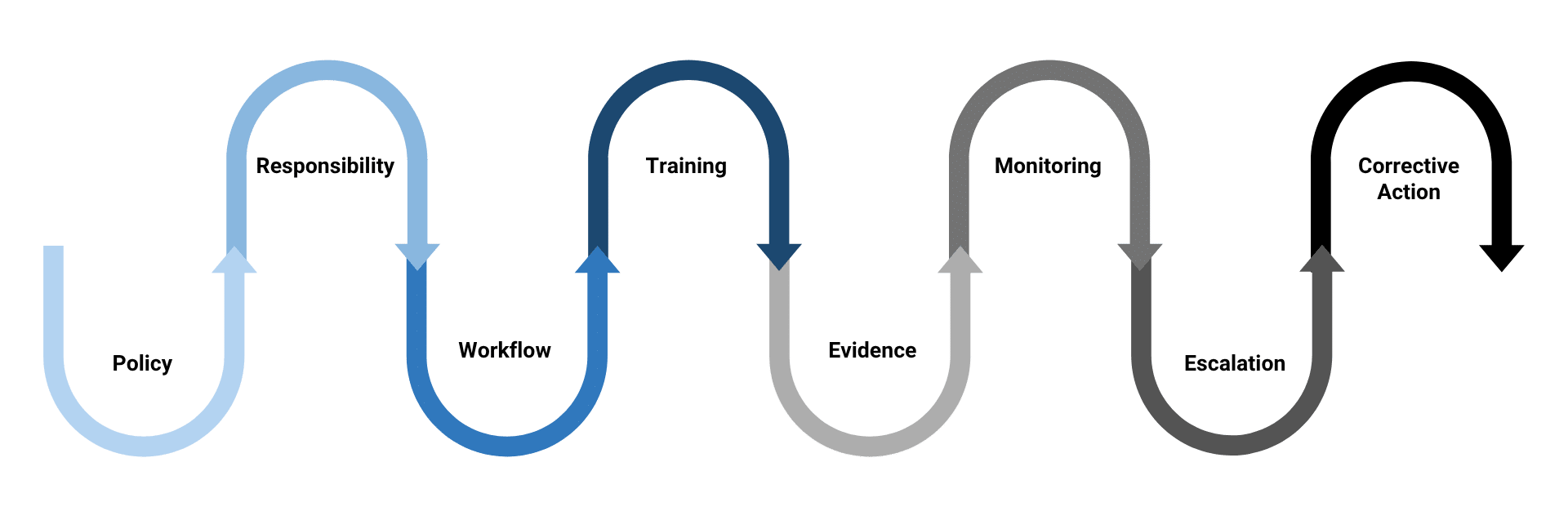
A HIPAA policy, for example, does not by itself demonstrate that user access is reviewed, audit logs are monitored when appropriate, staff are retrained when needed, or leadership receives meaningful compliance reporting.
Similarly, an incident-response policy does not prove that incidents are consistently documented, escalated, analyzed, corrected, and reviewed for recurring patterns.
A compliant-looking document environment can create false confidence if leadership has no reliable way to verify implementation.
For executives, that creates an important distinction: documentation may establish an expectation, but operational evidence demonstrates whether the expectation is being followed.
Governance Gaps That Create Audit Risk
Many compliance weaknesses begin with an operational question that was never clearly answered:
Who owns this?
Strong behavioral health compliance governance does not require every executive to manage every compliance task. It does require the organization to establish clear responsibility, reporting, escalation, oversight, and follow-through.
Unclear Ownership of Compliance Responsibilities
Assigning someone a general responsibility for “compliance” is not the same as establishing operational accountability.
Organizations need clarity around:
- Who monitors the requirement?
- Who receives findings?
- Who escalates problems?
- Who completes remediation?
- Who verifies completion?
- Who determines whether corrective action worked?
- Who reports unresolved risk to leadership?
Without that structure, several people may participate in a process while no one owns the full cycle.
Leadership may believe an issue is “being handled,” while monitoring, reporting, escalation, or follow-through remains incomplete.
Limited Leadership Reporting
Leadership cannot manage compliance risk it cannot see.
Executives need an appropriate mechanism for understanding meaningful trends and unresolved concerns, including:
- incidents,
- overdue training,
- documentation issues,
- audit findings,
- privacy or security concerns,
- vendor risks,
- and corrective actions that remain open.
The reporting method will vary by organization. The underlying principle should not: significant compliance issues should not remain indefinitely contained within individual departments without appropriate governance visibility.
Weak Committee or Meeting Structure
Compliance discussions that occur only after an incident, complaint, audit request, or other problem are inherently reactive.
A structured governance cadence, whether through compliance meetings, quality reviews, risk discussions, leadership dashboards, or another formal mechanism, creates a repeatable way to surface issues, document decisions, assign accountability, and verify follow-through.
Without that structure, organizations can repeatedly discuss problems without building an organizational record of how risks were identified and addressed.
No Central Risk Register or Compliance Workplan
Behavioral health organizations may have numerous known compliance concerns without a single mechanism for understanding them collectively.
A living risk register or compliance workplan can help leadership answer:
- What risks have been identified?
- How significant are they?
- Who owns each risk?
- What corrective action is required?
- When is action due?
- What evidence will demonstrate completion?
- Has remediation actually reduced or resolved the risk?
Without centralized visibility, issues may receive attention only after an audit, complaint, incident, breach concern, payer review, or licensing finding.
Lack of Corrective Action Follow-Through
Identifying a problem is not the same as resolving it.
A meaningful corrective-action process should create visibility into:
- the underlying issue or root cause,
- required actions,
- responsible owners,
- deadlines,
- evidence of completion,
- and an appropriate effectiveness review.
Organizations can create risk when corrective actions remain informal, discussed in meetings, assigned verbally, or partially completed without clear closure.
The leadership question is not simply, “Do we have a compliance program?”
It is:
“What evidence tells us the program is functioning as intended?”
That shift moves the discussion from policy ownership to operational accountability.
Who monitors the process? What information reaches leadership? How are exceptions escalated? Who owns remediation? How does the organization know corrective actions were completed? And what evidence demonstrates that the underlying issue was actually resolved?
For leadership teams, compliance becomes much more actionable when it is viewed as a governance and operational system rather than a collection of policies and annual requirements.

Documentation and Workflow Breakdowns That Compliance Audits Expose
Governance weaknesses eventually become visible through daily work.
The compliance problem may surface in a chart, training record, incident report, system-access process, or vendor file. But the underlying issue is often that the organization has not created enough consistency, oversight, or evidence around the workflow.
Clinical Documentation Inconsistency
Behavioral health documentation may vary among clinicians, programs, locations, and service lines.
Potential audit concerns can include:
- missing signatures,
- incomplete treatment plans,
- inconsistent progress notes,
- weak support for medical necessity,
- or poor alignment between services delivered and documentation.
The leadership issue is broader than an individual documentation error.
Executives should understand whether documentation expectations are clearly established, consistently reinforced, monitored for variation, and corrected when patterns emerge.
Training and Acknowledgement Gaps
Training is another area where completion and evidence can diverge.
An organization may provide orientation or compliance education but struggle to demonstrate consistent records of required or organization-defined refreshers, acknowledgements, role-specific education, or corrective retraining.
Leadership should therefore evaluate both sides of training:
Did staff receive the appropriate education, and can the organization demonstrate it?
Training should also connect to operational accountability. When a compliance issue occurs, organizations should be able to determine whether the problem reflects an isolated performance issue, inadequate training, unclear expectations, or a broader workflow weakness.
Incident Reporting Breakdowns
An incident-management process creates limited organizational learning if reports are incomplete, delayed, inconsistently reviewed, or disconnected from corrective action.
A stronger process creates a closed loop:
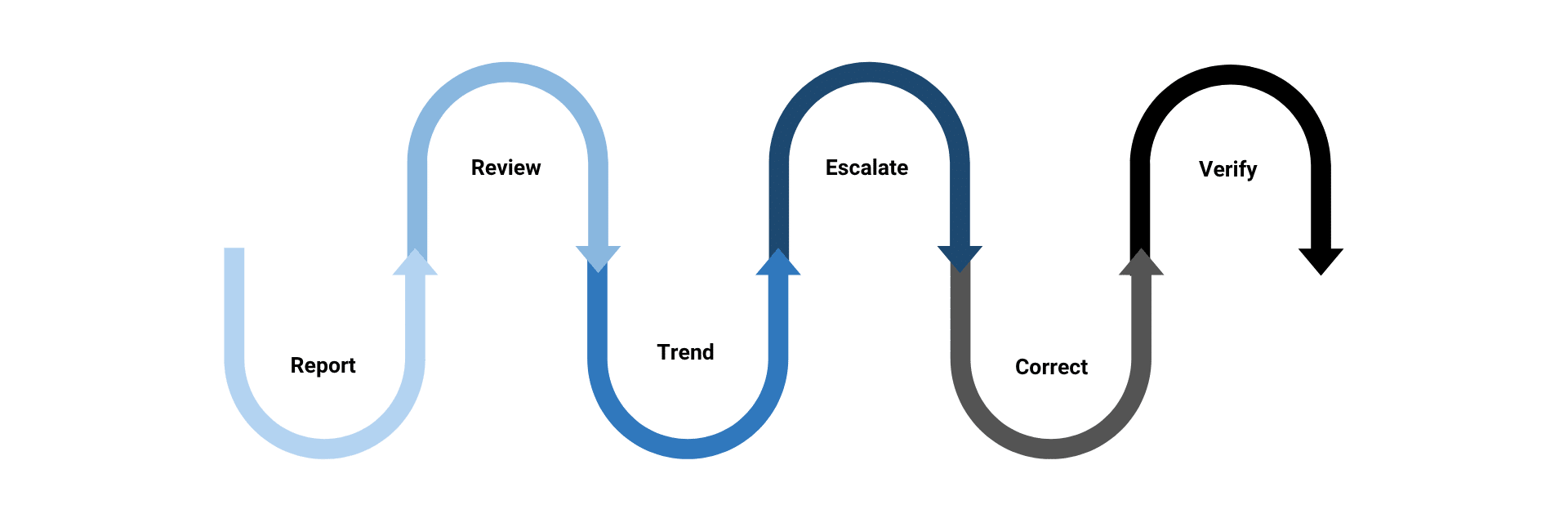
When that loop breaks, recurring events can remain fragmented rather than becoming visible organizational risks.
Leadership should be particularly attentive to repeated incidents or near misses. Recurrence may indicate that earlier remediation addressed an individual event without sufficiently addressing the underlying process.
HIPAA Privacy and Security Workflow Gaps
HIPAA privacy and security responsibilities are particularly dependent on operational execution.
Areas leaders may need to evaluate include:
- user access management,
- role-based permissions,
- access changes when staff responsibilities change,
- termination workflows,
- privacy and security incident escalation,
- audit or activity monitoring where appropriate,
- device management,
- and vendor oversight.
The U.S. Department of Health and Human Services’ HIPAA Security Rule guidance outlines the administrative, physical, and technical safeguards required to protect electronic protected health information.
The existence of a HIPAA policy does not establish whether these activities are consistently performed or documented.
For governance purposes, leadership should understand who owns each process, how compliance is monitored, what happens when an exception occurs, and how unresolved concerns reach the appropriate decision-makers.
Vendor and BAA Oversight Gaps
Behavioral health organizations often depend on EHR vendors, billing companies, IT providers, consultants, cloud platforms, and other third parties.
That dependency creates another governance question:
Who maintains visibility into the vendor relationship from a compliance perspective?
Organizations should understand which vendors may require business associate agreements, whether applicable agreements are current, where those documents are maintained, who monitors vendor-related risk, and how issues are escalated.
Vendor oversight can become particularly vulnerable when responsibility is distributed among operations, IT, finance, compliance, and leadership without a clearly established owner.
Compliance Governance Readiness Checklist
This leadership review is not intended to replace a comprehensive compliance audit or regulatory checklist. Its purpose is to help executives evaluate whether governance, operational accountability, and evidence are strong enough to support compliance readiness.
|
Compliance Area |
What Leadership Should Review |
Common Gap |
Risk Priority |
|
Policies and procedures |
Are policies current, approved, accessible, and aligned with operations? |
Written policies do not reflect actual workflows. |
High |
|
Staff training and acknowledgement |
Is applicable training documented, role-specific, and refreshed as appropriate? |
Training records or acknowledgements are incomplete. |
High |
|
Incident reporting |
Are incidents reported, reviewed, trended, and appropriately escalated? |
Reports are incomplete or disconnected from corrective action. |
High |
|
HIPAA privacy and security practices |
Are privacy, access, security, and incident workflows actively monitored? |
Policies exist, but evidence of operational monitoring is limited. |
High |
|
Documentation standards |
Are clinical and operational documentation expectations consistent? |
Standards vary by provider, location, or program. |
High |
|
Audit logs and monitoring |
Are applicable system-access and activity records reviewed when appropriate? |
Logs exist without clear review or follow-through. |
Medium–High |
|
Corrective action |
Are findings assigned, tracked, completed, and appropriately evaluated? |
Actions are discussed but not closed with evidence. |
High |
|
Vendor/BAA oversight |
Are applicable vendors tracked and BAAs maintained? |
Documentation is outdated, missing, or decentralized. |
Medium–High |
|
Leadership reporting |
Does leadership receive meaningful compliance trend information? |
Operational issues do not reach governance review. |
High |
|
Ongoing compliance review |
Is readiness evaluated proactively? |
Review begins only after a problem or external request surfaces. |
High |
The value of this exercise is not simply completing the table. The more important test is whether leadership can answer these questions with evidence rather than assumption.
Why Leadership Accountability Matters in Compliance Readiness
Behavioral health compliance cannot effectively sit with one Compliance Officer, administrator, clinical leader, IT professional, or other single individual.
Compliance crosses functions.
Leadership should therefore be able to answer several fundamental questions:
- Who owns overall compliance oversight?
- Who reviews incident patterns?
- Who monitors HIPAA privacy and security workflows?
- Who verifies applicable staff training?
- Who monitors documentation quality?
- Who owns corrective actions?
- Who maintains vendor and BAA oversight?
- Who elevates significant compliance risks?
- Who verifies that findings have actually been resolved?
The objective is not to make every executive responsible for every compliance activity.
The objective is to establish clear accountability and reliable visibility.
When leadership cannot clearly identify ownership, reporting cadence, escalation responsibility, and evidence of follow-through, that uncertainty itself may indicate a governance weakness.
How Behavioral Health Organizations Can Evaluate Compliance Readiness Before an Audit
A useful readiness review compares what the organization expects to happen with what is actually happening.
Leadership can begin with ten practical steps:
- Review policies against actual workflows. Confirm that written requirements reflect how staff currently perform the work.
- Confirm training records and acknowledgements. Determine whether applicable education is completed, documented, and connected to job responsibilities.
- Audit a representative sample of clinical documentation. Look for consistency across providers, programs, and locations.
- Review incident reporting and corrective-action history. Determine whether incidents are being reported, trended, escalated, corrected, and appropriately closed.
- Evaluate HIPAA privacy and security practices. Compare written expectations with actual operational practices.
- Review system access and termination workflows. Confirm that access responsibilities, role changes, and departures are managed consistently.
- Review vendor and BAA oversight. Determine whether applicable vendors and agreements are centrally visible and current.
- Evaluate leadership reporting and committee documentation. Assess whether significant risks are consistently reaching the appropriate governance level.
- Identify and prioritize gaps by operational risk. Not every finding carries the same significance or urgency.
- Create a corrective-action plan with clear ownership and follow-through. Assign responsible owners, deadlines, completion evidence, and appropriate effectiveness checks.
The goal is not to create a perfect compliance binder.
The goal is to determine whether the organization can demonstrate that compliance expectations are embedded into normal operations and whether leadership has enough visibility to recognize when they are not.
Leaders who want a more tactical review tool can also use John Lynch & Associates' compliance audit checklist to examine common risk areas before an external review.
When Compliance Gaps Warrant a More Structured Assessment
An internal readiness review can help leadership identify obvious concerns. There are also circumstances in which a more structured and objective assessment may be appropriate.
Behavioral health organizations may benefit from a HIPAA Risk & Compliance Assessment when:
- Leadership is uncertain whether policies reflect current operations.
- Growth has added locations, programs, services, vendors, or operational complexity.
- Turnover has affected compliance, operations, IT, billing, or clinical leadership.
- The organization is preparing for a payer audit, licensing review, accreditation survey, or other internal or external review.
- Privacy and security practices have not been evaluated recently.
- Incident reporting, corrective action, or documentation processes appear inconsistent.
- Vendor oversight, BAAs, system access, or monitoring activities have not been reviewed centrally.
- Leadership wants an objective view of readiness before an external reviewer identifies weaknesses.
A structured assessment becomes particularly valuable when leaders know individual concerns exist but cannot determine whether those issues are isolated or symptoms of a broader governance problem.
The purpose should not simply be to produce another list of deficiencies.
A useful assessment should help leadership understand where risk exists, why it exists, who needs to address it, and what should be prioritized first.

Conclusion
A behavioral health compliance audit does more than test whether required documents can be produced. It can reveal whether leadership has built the operational structure necessary to translate compliance expectations into consistent practice.
Policies matter. So do training, documentation, privacy and security, incident management, vendor oversight, and corrective action.
But the element connecting all of them is governance: clear ownership, meaningful monitoring, appropriate escalation, leadership visibility, and documented follow-through.
Behavioral health leaders should therefore ask more than whether a compliance program exists.
They should ask:
Can we demonstrate that it is functioning across the organization?
When the answer is uncertain, a structured review can help leadership identify gaps before an external audit, complaint, incident, or other event exposes them.
A HIPAA Risk & Compliance Assessment can provide an objective way to evaluate whether policies, documentation, workflows, staff practices, privacy and security controls, vendor oversight, leadership reporting, and corrective-action processes are operating as intended and help leadership establish a practical path for addressing priority risks.
Schedule a Compliance Risk Discussion to determine whether a structured assessment is appropriate for your organization.
Fequently Asked Questions
Common governance weaknesses include unclear ownership, inconsistent leadership reporting, weak monitoring processes, incomplete corrective-action tracking, decentralized vendor oversight, and a lack of structured risk management. These conditions can make individual compliance problems harder to identify and resolve because responsibility and follow-through are fragmented across departments. Leadership should evaluate not only whether compliance activities exist, but also who owns them, how they are monitored, and whether unresolved issues are escalated appropriately.

Not Sure Where to Start?
Whether you're preparing to launch a new healthcare organization, addressing compliance concerns, improving operational performance, evaluating technology investments, or looking to strengthen workflows, the right assessment can help identify risks, uncover opportunities, and prioritize next steps.