Published: 08/20/2025
Share this article

Article Updated September 2026
Healthcare organizations improve operational efficiency by identifying workflow bottlenecks, reducing unnecessary steps, clarifying staff responsibilities, strengthening reporting, and fixing operational problems that affect patient access, documentation, billing, and staff capacity. Sustainable improvement starts with understanding the root cause of performance gaps before implementing solutions.
Operational problems rarely exist in isolation. A documentation backlog can delay billing. Scheduling inefficiencies can reduce provider capacity. Poor reporting can leave leadership unaware of declining productivity, denials, or cash-flow problems until the impact becomes significant.
Effective performance improvement requires leaders to understand how workflow, staffing, technology, billing, reporting, and accountability interact across the organization.
Table of Contents
Hide
- 1. What Is Healthcare Performance Improvement?
- 2. How Can Healthcare Organizations Improve Operational Efficiency?
- 3. What Are the Warning Signs of Operational Inefficiency in Healthcare?
- 4. What Are Examples of Performance Improvement in Healthcare?
- 5. How Can Workflow Design Affect Staff Capacity?
- 6. What Is a Practical Framework for Healthcare Performance Improvement?
- 7. Efficiency Is a Strategy, Not Just a Goal
- 8. Related Articles
- 9. Fequently Asked Questions
- 10. Not Sure Where to Start?
What Is Healthcare Performance Improvement?
Healthcare performance improvement is the structured process of identifying operational, clinical, financial, and workflow gaps, correcting their root causes, and measuring whether those changes improve efficiency, care delivery, financial performance, or organizational stability.
It is not a one-time initiative, but a leadership-driven discipline grounded in data, strategy, and system-wide collaboration.
At its core, performance improvement asks a simple but powerful question: How can we deliver better care with fewer obstacles and more value?
Organizations focused on performance improvement typically aim to:
- Improve care delivery by minimizing variation and standardizing best practices
- Optimize workflows to reduce bottlenecks, delays, and rework
- Enhance patient outcomes through coordinated, high-quality care
- Control costs by eliminating waste and aligning resources more effectively
Across ambulatory care, tribal health, and behavioral health systems, performance improvement is essential for long-term sustainability. It enables leaders to respond to rising operational complexity, workforce shortages, and shifting reimbursement models with agility and foresight.
Importantly, performance improvement must be embedded into the organizational culture; not siloed to a single department or project team. When improvement becomes everyone’s responsibility, it drives smarter decisions, better patient experiences, and more resilient systems.
Many of the organizations we work with begin their improvement journey by focusing on a single domain, such as revenue cycle performance or clinical documentation. From there, small wins lead to broader transformation.
A behavioral health group we worked with began by making a small improvement in how they tracked key performance indicators starting with monitoring no-show rates for appointments. By implementing a simple reporting process and reviewing trends weekly, the team quickly identified gaps in reminder calls and patient engagement.
This visibility not only helped reduce missed appointments but also highlighted other opportunities to measure and manage performance, such as clinician productivity and payer reimbursement trends.
What began as a small data-tracking initiative evolved into a culture of data-driven decision-making, resulting in stronger operational oversight, better resource allocation, and a notable increase in revenue stability.
To create sustainable performance improvements, we often guide clients through a structured operational assessment. Our consultants at John Lynch & Associates examine what isn’t working, and why. This reveals hidden friction points and allows teams to address root causes, not just surface-level symptoms.
Ultimately, performance improvement isn't just about efficiency. It’s about building systems that support high-quality care, foster staff well-being, and deliver on your mission in an increasingly complex healthcare landscape.
For organizations seeking expert support in identifying inefficiencies, aligning teams, and implementing lasting change, our practice management consulting services offer a proven, people-first approach to driving performance at every level of the organization.
How Can Healthcare Organizations Improve Operational Efficiency?
Healthcare organizations improve operational efficiency by streamlining workflows, aligning teams, reducing friction in care delivery, and using reliable performance data to guide decisions. The goal is to eliminate avoidable work, improve capacity, and address the root causes of operational and financial performance problems.
Streamlining Workflows to Reduce Waste
Every inefficient workflow hides time, money, and potential clinical risk. From intake to discharge, even small breakdowns (duplicative steps, redundant data entry, or delayed handoffs) add up to major losses in productivity and morale.
Streamlining workflows involves:
- Mapping end-to-end processes to uncover friction points
- Identifying non-value-added steps that can be automated, eliminated, or consolidated
- Standardizing best practices across care teams and locations
When done effectively, this doesn’t just increase speed, it improves consistency, reduces variation, and strengthens team trust.
One of our outpatient behavioral health clients began with a seemingly small improvement: reducing the time it took clinicians to complete progress notes after each session. By streamlining workflows and standardizing documentation templates, providers were able to finish charts more quickly, freeing up valuable time for patient care.
What started as a time-saver for clinicians soon created ripple effects; documentation accuracy improved, claims were submitted faster, and denials dropped significantly. Within months, the clinic saw measurable gains in billing compliance and revenue capture, transforming what began as an operational efficiency project into a sustained increase in profitability and overall organizational performance.
Organizations experiencing recurring bottlenecks, redundant steps, or inconsistent handoffs may benefit from a more structured healthcare workflow assessment and redesign process.
If recurring bottlenecks, rework, or inconsistent handoffs are difficult to isolate, a structured workflow review can help clarify where processes may need attention.
Explore Practice Management Consulting
Aligning Teams with Organizational Goals
Healthcare teams often work in silos; not because they want to, but because systems unintentionally disconnect their goals and communication pathways. Misalignment can lead to inconsistent performance, competing priorities, and lower staff engagement.
Improving performance requires clear alignment across clinical, operational, and administrative teams. This includes:
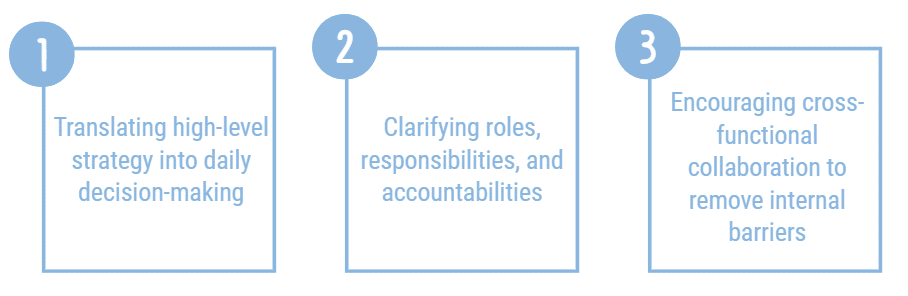
When everyone knows where the organization is headed, and how their role supports it, teams work with more focus, flexibility, and purpose.
Reducing Friction in Care Delivery
Even the best-intentioned clinical teams struggle when care delivery is bogged down by complexity. Friction shows up in multiple ways:
- Long wait times due to scheduling inefficiencies
- EHR workflows that require excessive clicks or duplicate documentation
- Poor care coordination between departments or providers
Removing friction in care delivery is both a performance and a patient experience imperative. It allows providers to spend more time on care (not navigation) and it leads to better clinical outcomes and higher patient satisfaction.
This is often where performance improvement efforts gain early traction, because small changes (like adjusting appointment templates or reworking intake forms) can deliver immediate relief.
Using Data to Drive Strategic Change
Data is the foundation of every effective performance improvement effort, but only when it’s used well. Many organizations collect plenty of data, but lack a unified approach to analysis, interpretation, and decision-making.
To drive change, we help clients:
- Establish relevant, role-specific KPIs for each department
- Create dashboards that provide real-time visibility into performance
- Use baseline and trend data to inform priorities and measure impact
Reviewing the right revenue cycle performance metrics can also help leaders identify financial and operational trends that may warrant closer attention.
Without reliable metrics, teams operate on assumptions. With data, they can make faster, smarter decisions that lead to sustained improvement. When organizations activate all four levers - streamlined workflows, team alignment, friction reduction, and data-driven change, they unlock scalable, repeatable improvements that benefit every stakeholder in the health system.
When performance concerns extend across workflows, billing, reporting, or EHR processes, reviewing the current state can help leadership determine which issues warrant priority attention.
Learn about the Operational & Billing Readiness Review
What Are the Warning Signs of Operational Inefficiency in Healthcare?
Common warning signs include recurring workflow bottlenecks, documentation backlogs, rising denials, inconsistent staff processes, scheduling delays, unreliable reporting, frequent workarounds, and leadership repeatedly addressing the same operational problems.
| Warning Sign | What It May Indicate |
|---|---|
| Documentation backlogs | Workflow, staffing, training, or EHR problems |
| Rising denials | Intake, authorization, documentation, coding, or billing gaps |
| Scheduling delays | Capacity or workflow design problems |
| Staff workarounds | Systems or processes that do not match actual operations |
| Inconsistent performance by team/location | Lack of standardization or accountability |
| Poor KPI visibility | Reporting or governance weakness |
| Recurring compliance issues | Training, process, or monitoring gaps |
| Leadership constantly resolving the same problems | Root causes have not been addressed |
What Are Examples of Performance Improvement in Healthcare?
Healthcare organizations can achieve measurable gains by focusing on small, targeted improvements that build momentum over time. Below are common examples of performance improvement in healthcare settings:
- Reducing time to chart completion to accelerate billing and improve documentation quality
- Increasing clean claim rates by refining coding workflows and front-end accuracy
- Cutting patient wait times by redesigning scheduling templates and intake processes
- Improving clinical documentation to minimize audit risk and ensure compliance
- Streamlining staff onboarding to reduce ramp-up time and ensure role readiness
These outcomes are not the result of isolated initiatives; they’re often the product of coordinated, system-wide efforts grounded in operational insight and frontline feedback.
From Theory to Action
Many performance improvement projects begin with a single pain point. A clinic notices consistent delays in patient check-in. A behavioral health center faces recurring documentation backlogs. A tribal health facility struggles with claim rejections due to inconsistent coding.
In each case, the solution starts with an assessment of what’s happening behind the scenes.
- Are teams unclear on responsibilities?
- Is technology getting in the way?
- Are inefficient handoffs or redundant steps creating delays?
Even a small change, like redesigning an intake form, restructuring appointment templates, or standardizing documentation protocols, can yield significant impact. These actions reduce administrative burden, accelerate revenue capture, and give clinical teams more time to focus on patients.
What’s important is not just the tactic, but the approach. Organizations that commit to continuous improvement, rather than one-off fixes, create lasting systems that adapt to change, scale with growth, and protect against compliance risk.
For practical resources to support your own performance improvement efforts, the CDC Quality Improvement Toolkit offers helpful frameworks for tracking, measuring, and managing progress over time.
How Can Workflow Design Affect Staff Capacity?
Workflow design can influence how staff time is used across clinical and administrative tasks. Repetitive steps, manual workarounds, unclear handoffs, and poorly aligned systems may increase administrative effort and reduce the time available for higher-value work.
What Is a Practical Framework for Healthcare Performance Improvement?
A practical healthcare performance improvement framework starts by assessing the current state, aligning teams around priorities and accountability, and acting on measurable changes. This approach can help leaders address root causes rather than focusing only on individual symptoms.
We use a three-phase framework: Assess → Align → Act, to help organizations move from insight to implementation in a way that’s sustainable, measurable, and centered on people.
This framework works across all care settings and organizational sizes, from tribal health centers and community clinics to large ambulatory systems and behavioral health networks.
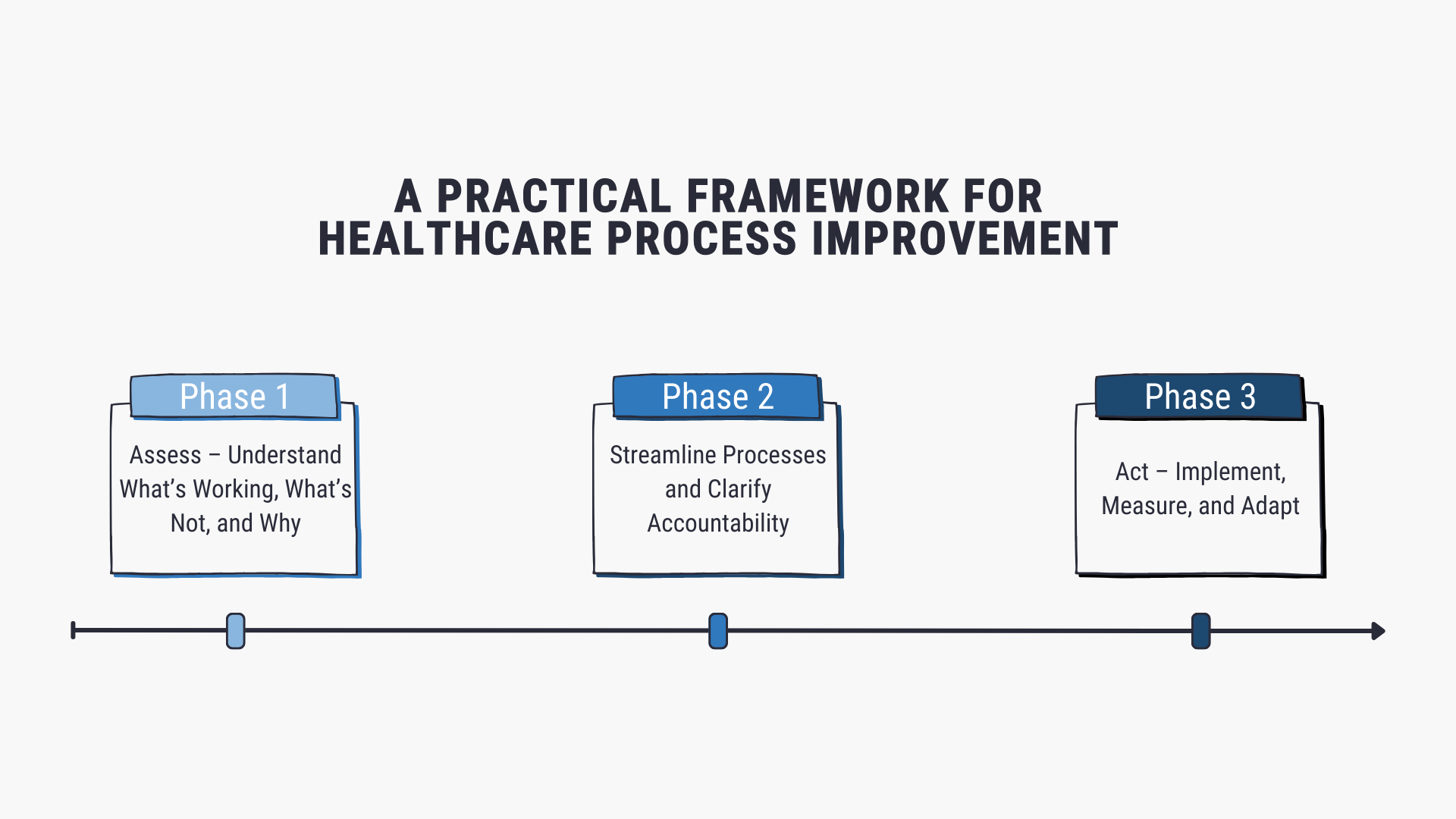
Phase 1: Assess – Understand What’s Working, What’s Not, and Why
Performance improvement starts with clarity. Before making changes, organizations need to understand the current state of operations beyond surface-level metrics.
We guide teams through a comprehensive assessment using a combination of:
- Staff and stakeholder feedback (surveys, interviews, workshops)
- Workflow audits that trace clinical and administrative processes end to end
- Performance metrics (e.g., productivity, patient flow, claim denial rates)
This phase often reveals:
- Bottlenecks that delay care or increase costs
- Rework loops that waste time and frustrate staff
- Breakdowns in communication between departments or systems
- Missed benchmarks in areas like access, throughput, or compliance
And just as importantly, it helps surface cultural or organizational dynamics that may be holding teams back.
When assessing workflows, we also pay close attention to areas of compliance vulnerability, often a symptom of unclear processes or inconsistent documentation.
These issues often appear separately, but their root causes are frequently connected. A structured operational assessment can give leadership a broader view of how workflows, staffing, technology, billing, reporting, accountability, and performance measures interact before improvement initiatives are prioritized.
For organizations experiencing billing issues, workflow inconsistencies, limited performance visibility, EHR inefficiencies, or unclear operational accountability, John Lynch & Associates’ Operational & Billing Readiness Review provides a focused way to identify the highest-priority gaps and establish a practical improvement roadmap.
Phase 2: Align – Streamline Processes and Clarify Accountability
Once the root causes of underperformance are clear, the next step is aligning people, processes, and goals around a shared improvement strategy.
This phase includes:
- Clarifying roles and responsibilities across teams and departments
- Streamlining cross-functional processes to remove duplication and confusion
- Linking operational workflows to clinical, financial, and compliance outcomes
- Reinforcing shared accountability so that performance improvement isn’t siloed
Alignment creates a strong foundation for execution. It ensures that improvement is not just a leadership initiative, but a shared commitment across clinical, administrative, and operational teams.
In our experience, this phase is where many organizations see an immediate morale boost, because teams now have clarity, purpose, and support in doing their best work.
Phase 3: Act – Implement, Measure, and Adapt
In the final phase, we work with leadership teams to turn alignment into action by setting priorities, implementing change, and tracking results.
This includes:
- Prioritizing initiatives based on feasibility, impact, and urgency
- Assigning clear ownership for each improvement action
- Establishing KPIs and success metrics from the start
- Scheduling regular check-ins to evaluate progress and adjust course
Crucially, we help organizations resist the urge to launch too many initiatives at once. Focusing on a few high-impact changes creates momentum, demonstrates value, and builds confidence to scale.
This phase also reinforces that performance improvement is not a one-time project; it’s a cycle. As results come in, the organization re-enters the assessment phase with new data and new opportunities to refine and grow.
Whether your organization is looking to improve patient flow, reduce denials, or increase staff efficiency, this framework provides a structured, people-centered roadmap. It’s not about chasing quick wins. It’s about building the operational muscle to adapt, evolve, and lead.

Efficiency Is a Strategy, Not Just a Goal
Operational efficiency is not simply about moving faster. It is about creating processes, systems, and accountability structures that better support the way the organization needs to operate.
When inefficiencies persist across workflows, reporting, staffing, technology, or revenue cycle processes, leadership may see recurring operational friction without a clear view of the underlying causes. That is why performance improvement should begin with understanding where gaps are occurring and how they may be connected.
Questions leaders can consider include:
- Where are teams experiencing recurring delays or rework?
- Which workflows rely heavily on manual steps or workarounds?
- Where is performance difficult to measure or monitor?
- Are operational, financial, and clinical processes working together as intended?
- Which issues should be addressed first based on organizational priorities?
A structured review of the current state can help leadership identify where additional attention may be needed and establish a more focused approach to improvement.
For organizations experiencing workflow inconsistencies, billing challenges, EHR inefficiencies, reporting limitations, or unclear operational accountability, the Operational & Billing Readiness Review provides a focused way to evaluate priority gaps and develop a practical roadmap for next steps.
Explore the Operational & Billing Readiness Review
Explore Practice Management Consulting
Fequently Asked Questions
Healthcare performance improvement is the structured process of identifying clinical, operational, financial, and workflow gaps and making targeted changes to improve how the organization functions. It typically includes assessing current processes, defining priorities, implementing improvements, and monitoring results over time.

Not Sure Where to Start?
Whether you're preparing to launch a new healthcare organization, addressing compliance concerns, improving operational performance, evaluating technology investments, or looking to strengthen workflows, the right assessment can help identify risks, uncover opportunities, and prioritize next steps.