
Published: 11/12/2025
Share this article

Article Updated October 2026
Strategic planning in healthcare is the process of setting long-term priorities, assessing current conditions, aligning resources, assigning accountability, and measuring progress so an organization can move from goals to execution.
Strategic planning in healthcare gives leaders a structured way to set priorities, align resources, and translate long-term goals into measurable action.
For behavioral health, ambulatory care, and Tribal Health organizations, that often means making deliberate decisions about growth, workforce, operations, compliance, technology, and financial sustainability.
A useful strategic plan does more than state goals. It clarifies where the organization is now, where leadership intends to go, who owns execution, how progress will be measured, and when the organization should adjust course.
Table of Contents
Hide
- 1. What Is Strategic Planning in Healthcare?
- 2. What Should a Healthcare Strategic Plan Include?
- 3. What Are the 5 Steps in Strategic Planning for Healthcare?
- 4. What Tools Are Used for Strategic Planning in Healthcare?
- 5. What Are Examples of Strategic Planning in Healthcare?
- 6. How Healthcare Strategic Plans Should Adapt to Changing Conditions
- 7. What Are Common Strategic Planning Mistakes in Healthcare?
- 8. How Strategic Planning in Healthcare Supports Compliance and Growth
- 9. How Healthcare Leaders Keep a Strategic Plan Active Over Time
- 10. Final Thoughts on Strategic Planning in Healthcare
- 11. Need Help Turning Strategic Planning into Execution?
- 12. Related Articles
- 13. Fequently Asked Questions
- 14. Not Sure Where to Start?
What Is Strategic Planning in Healthcare?
Strategic planning in healthcare is the process of setting clear goals, identifying priorities, and aligning resources to support the organization’s long-term vision. It helps healthcare leaders look beyond day-to-day operations and take a broader view of where the organization is headed, how it will get there, and what success looks like.
Unlike operational or compliance planning, which focuses on immediate tasks and regulatory requirements, strategic planning in healthcare is forward-thinking. It addresses big-picture questions about growth, quality, service delivery, and sustainability. It also provides a structured framework for making decisions, allocating funding, and measuring performance over time.
By building a solid strategic plan, healthcare organizations can stay focused, adapt to change, and lead with intention even during uncertain times.
What Should Strategic Planning Accomplish in Healthcare?
At its core, strategic planning in healthcare means creating a roadmap that guides your organization toward specific goals. It begins with understanding where you are now, then outlining where you want to go and how you plan to get there. This includes setting priorities, developing timelines, assigning responsibilities, and tracking progress.
Strategic plans often cover areas like service expansion, workforce development, financial sustainability, community outreach, and regulatory readiness. They are designed to align leadership, departments, and teams under a unified mission while remaining flexible enough to adjust as needs evolve.
For additional guidance on the principles and structure of strategic healthcare planning, the American Hospital Association provides helpful strategic planning resources for healthcare leaders.
Why Is Strategic Planning Important in Healthcare?
Strategic planning is important in healthcare because it connects organizational priorities, resources, accountability, and measurable goals so leaders can make deliberate long-term decisions instead of continually reacting to immediate pressures.
Here’s why it matters:
- It keeps teams focused on shared goals instead of reacting to daily fire drills
- It helps align budgeting, staffing, and operations with long-term priorities
- It prepares your organization to handle external pressures like policy changes, patient surges, and funding shifts
- It increases accountability across departments by clearly defining roles, metrics, and timelines
Healthcare is a fast-moving field. Strategic planning in healthcare gives organizations a sense of control, clarity, and momentum when it is needed most.
For organizations preparing to launch, expand, or add services, strategic planning should connect growth decisions with operational capacity, compliance requirements, staffing, technology, and financial assumptions. John Lynch & Associates' strategic planning for healthcare clinics services help leadership translate those decisions into an actionable roadmap.
What Should a Healthcare Strategic Plan Include?
A healthcare strategic plan should connect the organization’s mission with a realistic assessment of current conditions, measurable priorities, clear ownership, and an ongoing process for evaluating progress.
Although the complexity of the plan will vary by organization, five core elements provide a practical foundation for leadership.
These elements help move strategic planning from broad intention to accountable execution.
| Core element | What leadership should define |
|---|---|
| Mission and vision | Where the organization is going and why |
| Environmental assessment | Internal strengths/gaps and external opportunities/risks |
| Strategic priorities and goals | What must be accomplished and how success will be measured |
| Implementation plan | Owners, resources, timelines, dependencies and responsibilities |
| Evaluation and adjustment | KPIs, review cadence and decisions about when to adapt |
Aligning Vision and Mission
A strategic plan is only effective if it reflects your organization’s true mission and values. Before setting goals or selecting initiatives, it is important to revisit your core purpose and ask whether your current direction supports it.
Your mission defines why your organization exists. Your vision outlines what you aspire to achieve. Strategic planning in healthcare connects both to actionable goals, ensuring that day-to-day operations serve the bigger picture. This alignment gives staff and stakeholders clarity and motivation to move in the same direction.
Conducting an Environmental Assessment
A realistic strategic plan begins with a clear understanding of the organization’s current state. Leadership should evaluate both internal conditions and external forces that could affect the organization’s ability to achieve its goals.
Internally, review areas such as staffing capacity, workflows, financial performance, care quality, compliance, EHR and technology capabilities, reporting, and infrastructure.
Externally, consider community needs, payer and reimbursement trends, regulatory changes, workforce conditions, competitors, and broader market shifts.
Tools such as SWOT or PESTLE analysis can help leadership organize these findings before establishing strategic priorities.
Goal Setting and Priorities
Once your vision is clear and your assessment is complete, it is time to define specific goals. Strategic planning in healthcare often fails when goals are too broad or unrealistic. We recommend using the SMART framework, which means goals should be Specific, Measurable, Achievable, Relevant, and Time-bound.
Some goals will focus on near-term wins, such as reducing no-show rates or improving billing turnaround. Others may look further ahead, such as expanding services or increasing community engagement. Prioritization is key. Choose what matters most based on your mission, resources, and readiness.
Creating an Implementation Framework
A plan is only valuable if it leads to action. That is why every strategic plan should include a clear implementation framework. This means outlining who is responsible for what, how progress will be tracked, and when milestones should be reached.
Assigning ownership across departments helps drive accountability. Setting realistic timelines keeps the plan moving forward. Building a communication plan ensures staff are informed, engaged, and empowered throughout the process.
When a strategic priority becomes a complex, multi-stakeholder initiative, structured healthcare project management can help translate the plan into defined scope, ownership, timelines, risk controls, and execution.
Evaluating and Improving Your Strategic Planning Process
Finally, strategic planning in healthcare must include regular evaluation. This is how organizations learn, improve, and stay responsive to change.
Use performance metrics and KPIs to track progress toward each goal. Set review points quarterly or annually to assess what is working and what needs to shift. A good plan is a living document. The more you revisit and refine it, the more effective it becomes over time.
For more information on linking quality goals to performance, refer to the CMS Quality Strategy, which offers insights into aligning clinical care with measurable outcomes.
What Are the 5 Steps in Strategic Planning for Healthcare?
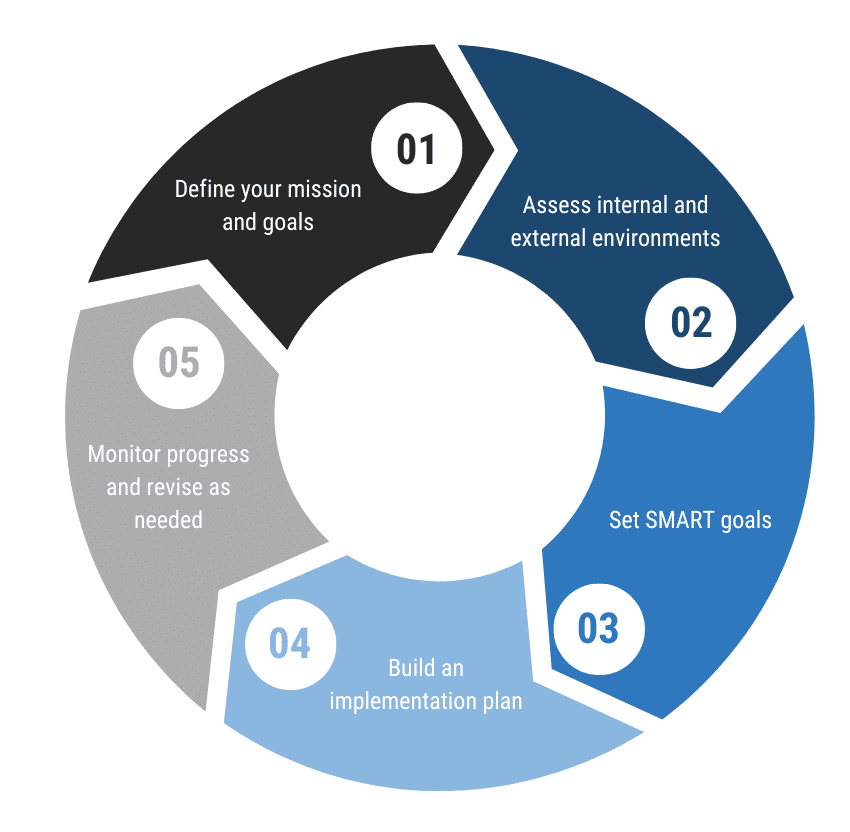
A practical healthcare strategic planning process can be organized into five steps:
1. Align the mission and vision. Confirm the organization’s purpose, long-term direction, and leadership priorities.
2. Assess the current environment. Evaluate internal performance, workforce, workflows, finances, technology, compliance requirements, community needs, and external market conditions.
3. Establish strategic priorities and measurable goals. Determine which initiatives matter most and define the outcomes, KPIs, and timelines leadership will use to measure success.
4. Build the implementation plan. Assign ownership, resources, responsibilities, milestones, dependencies, and communication expectations.
5. Measure, review, and adapt. Monitor performance regularly, evaluate whether priorities remain appropriate, and adjust the plan as conditions change.
This framework keeps strategic planning structured enough to create accountability while allowing leadership to adapt as organizational needs and external conditions evolve.
What Tools Are Used for Strategic Planning in Healthcare?
Healthcare leaders can use several strategic planning tools to organize information, evaluate options, and measure whether priorities are producing the intended results. The right tool depends on the decision being made and the organization’s stage of planning.
| Strategic Planning Tool | How Healthcare Leaders Can Use It |
|---|---|
| SWOT analysis | Identify internal strengths and weaknesses along with external opportunities and threats |
| PESTLE analysis | Evaluate political, economic, social, technological, legal, and environmental forces |
| SMART goals | Turn broad priorities into specific and measurable objectives |
| KPI dashboards | Track whether strategic initiatives are producing intended results |
| Scenario planning | Prepare for different regulatory, financial, workforce, technology, or market conditions |
Strategic planning tools should support leadership decisions rather than become the planning process itself. The goal is to use the right level of analysis to identify priorities, make informed decisions, and maintain accountability for execution.
What Are Examples of Strategic Planning in Healthcare?
Strategic planning looks different depending on the organization, market, and decision leadership is facing. The common thread is connecting a long-term objective with the operational, financial, regulatory, technology, and workforce requirements needed to achieve it.
Behavioral Health: An organization preparing to launch an intensive outpatient program may evaluate patient demand, licensing requirements, clinical staffing, payer enrollment, EHR workflows, financial assumptions, and implementation milestones before determining when and how to expand.
Ambulatory Care: A medical practice considering a new service line may assess patient demand, provider capacity, payer mix, scheduling, revenue cycle requirements, technology needs, and expected financial performance before committing resources.
Tribal Health: A Tribal health organization considering mobile or telehealth expansion may align community needs, governance, funding, workforce capacity, technology, clinical workflows, and long-term sustainability within one strategic roadmap.
How Healthcare Strategic Plans Should Adapt to Changing Conditions
Healthcare strategic plans should provide direction without becoming rigid. Patient demand, workforce availability, reimbursement, regulatory requirements, technology, funding, and community needs can all change after a plan is approved.
Effective strategic planning builds in regular review points and enough flexibility for leadership to respond to meaningful changes without losing sight of the organization’s long-term priorities. Seasonal fluctuations are one example of why this adaptability matters.
Understanding Seasonal Trends in Healthcare Demand
Seasonal fluctuations are not just a hospital concern. Outpatient clinics, behavioral health programs, and tribal health departments all experience cyclical changes that impact access, staffing, and patient flow.
For example:
- Winter months often bring higher demand for urgent care, respiratory services, and social support
- Summer may lead to reduced staff availability due to vacations or burnout
- The school calendar can influence adolescent mental health appointments and pediatric care
Strategic planning in healthcare should include time each year to review data trends related to seasonal demand. Use past years as a benchmark to anticipate what is ahead and prepare your teams accordingly.
Building Flexibility Into the Strategic Plan
A good strategic plan does not just respond to change, it builds in the ability to flex. Healthcare leaders can strengthen seasonal planning by including strategies for resource reallocation, temporary program adjustments, and communication workflows that activate during peak times.
Examples include:
- Cross-training staff to fill high-need roles during seasonal surges
- Adding part-time or per-diem roles in anticipation of high-volume months
- Adjusting outreach and marketing strategies based on seasonal community needs
- Preparing supply chains for spikes in demand related to flu season or public health alerts
The key is to make seasonal readiness part of your strategic planning process, not an afterthought. By embedding flexibility into your annual goals and resource plans, your organization can operate with greater stability and resilience all year long.
The CDC offers guidance on planning for health-care system emergencies and surge demand, which can be adapted for local or regional use.
What Are Common Strategic Planning Mistakes in Healthcare?
Even with the best intentions, many healthcare organizations struggle to get strategic planning right. Common missteps can stall progress, waste resources, and leave teams feeling disconnected from the bigger picture. Recognizing these pitfalls is an important part of building a more effective and lasting plan.
This section outlines key mistakes leaders often make during the strategic planning process and how to avoid them by focusing on clarity, inclusion, and follow-through.
Planning Without Data or Stakeholder Input
One of the most common mistakes in strategic planning in healthcare is building a plan based on assumptions rather than facts. Without current performance data or community insights, plans often miss the mark or focus on the wrong priorities.
Equally important is engaging the right voices early. Staff, patients, and community partners bring essential perspectives that can shape more grounded, actionable goals. When people feel included in the planning process, they are also more likely to support and follow through on the strategy.
Setting Vague or Unmeasurable Goals
A strategic plan that says “improve patient experience” or “enhance operations” lacks the clarity needed to drive action. Goals must be specific and measurable to move teams forward with purpose.
Strategic planning in healthcare works best when goals are clearly defined, tied to performance indicators, and tracked over time. Use SMART criteria to keep each objective focused and achievable. This helps departments understand their roles and creates a system for accountability.
Letting the Plan Sit on the Shelf
Another common issue is creating a strategic plan and then never using it. If the plan is not integrated into regular operations, budget decisions, and staff communication, it quickly loses relevance.
Successful healthcare organizations use their strategic plan as a living document. Leadership refers to it during quarterly reviews, team meetings, and decision-making. The more visible and usable the plan is, the more likely it is to create real outcomes.
Failing to Review and Update the Plan
Healthcare environments change quickly. Strategic planning in healthcare must include regular reviews to stay aligned with new challenges, opportunities, and data.
Set a calendar for plan reviews whether quarterly, mid-year, or annually, and invite key stakeholders to help assess progress. Update goals and action steps as needed. Continuous improvement ensures the plan stays active and relevant.
When leadership is unsure whether the underlying issue is strategy, execution, compliance, billing, workflow, or technology alignment, a structured healthcare consulting assessment can establish the current-state baseline, identify material gaps, and prioritize the next steps.

How Strategic Planning in Healthcare Supports Compliance and Growth
Strategic planning in healthcare does more than guide internal goals. It also strengthens an organization’s ability to meet regulatory standards, improve care quality, and pursue meaningful growth. When a plan is built with intention and tied to measurable outcomes, it becomes a tool for compliance and long-term sustainability.
This section explores how a well-structured strategic plan supports both regulatory readiness and performance improvement while positioning your organization to expand and evolve with purpose.
Aligning Strategic Plans with Regulatory Requirements
Healthcare organizations operate within regulatory and accreditation environments that require clear governance, accountability, quality oversight, risk management, and performance improvement.
Strategic planning helps leadership incorporate these responsibilities into broader organizational priorities rather than managing them as disconnected compliance activities.
Federal agencies such as the Centers for Medicare & Medicaid Services (CMS), along with accrediting organizations such as The Joint Commission and CARF, establish requirements and expectations that can affect organizational priorities.
A strategic plan supported by current data, assigned ownership, measurable goals, and regular review can help leadership integrate regulatory readiness and quality improvement into long-term decision-making.
Using Strategic Planning to Drive Quality and Performance
A good strategic plan goes beyond compliance. It sets the stage for improving outcomes, enhancing staff performance, and delivering higher-quality care. When your goals are tied to data, tracked consistently, and owned by cross-functional teams, real progress becomes possible.
Strategic planning creates alignment across departments by establishing shared performance priorities and measurable expectations.
Depending on the organization, those priorities may include improving appointment access, documentation timeliness, denial rates, patient experience, care coordination, compliance monitoring, workforce performance, or other operational outcomes.
Connecting these measures to strategic goals gives leadership better visibility into whether planned improvements are actually occurring.
Building Scalable, Sustainable Growth Through Strategy
Growth in healthcare should be thoughtful, not reactive. Strategic planning gives leaders the tools to identify where to invest, which services to expand, and how to build capacity without compromising care quality or compliance.
Whether your organization is preparing to pursue new funding, scale existing programs, or open new locations, strategic planning provides the structure and foresight to manage change effectively. It also helps you anticipate operational needs, regulatory risks, and staffing challenges that may emerge as you grow.

How Healthcare Leaders Keep a Strategic Plan Active Over Time
A strategic plan creates value only when leadership continues to use it. Once priorities have been established, healthcare leaders need a consistent governance process for reviewing progress, resolving barriers, and determining when changes are necessary.
Leadership teams should establish a regular review cadence, define who owns each strategic priority, and make performance information visible enough to support decision-making. Strategic priorities should also inform budgeting, staffing, technology investments, operational initiatives, and other significant resource decisions.
When performance falls behind expectations, leadership should determine whether the issue is execution, resources, changing conditions, or the strategy itself. This ongoing discipline keeps the strategic plan connected to real organizational decisions instead of allowing it to become a document that is reviewed only once a year.
Final Thoughts on Strategic Planning in Healthcare
Strategic planning in healthcare creates value when it helps leadership make clearer decisions about priorities, resources, accountability, and execution. The plan itself is only one part of the process; the greater value comes from the discipline of assessing current conditions, setting measurable priorities, assigning ownership, and reviewing whether the organization is actually moving in the intended direction.
Strong strategic plans also remain flexible. Regulatory requirements, workforce conditions, reimbursement, technology, patient demand, and organizational capacity can change, and leadership should be prepared to adjust when the evidence supports a different course.
Before the next planning cycle begins, leadership should be able to explain the organization’s highest priorities, why they matter, who owns execution, how progress will be measured, and what conditions would require the strategy to change.
Need Help Turning Strategic Planning into Execution?
Strategic planning often reveals questions that go beyond the plan itself. Leadership may uncover gaps involving operational readiness, compliance, billing, workflows, technology, staffing, or the organization’s ability to execute planned growth.
John Lynch & Associates’ healthcare consulting assessments help leadership establish a current-state baseline, identify material gaps, and prioritize practical next steps before committing to a larger initiative.
Request an Assessment
Fequently Asked Questions
Strategic planning in healthcare is the process of defining long-term priorities, assessing current conditions, aligning resources, assigning accountability, and measuring progress. It helps leadership connect the organization’s mission and goals with practical decisions about operations, workforce, finances, technology, compliance, growth, and patient or community needs.

Not Sure Where to Start?
Whether you're preparing to launch a new healthcare organization, addressing compliance concerns, improving operational performance, evaluating technology investments, or looking to strengthen workflows, the right assessment can help identify risks, uncover opportunities, and prioritize next steps.