
Published: 07/27/2026
Share this article

Ambulatory clinics should review EHR performance metrics that reveal workflow bottlenecks, revenue cycle risk, staff adoption issues, and patient access challenges.
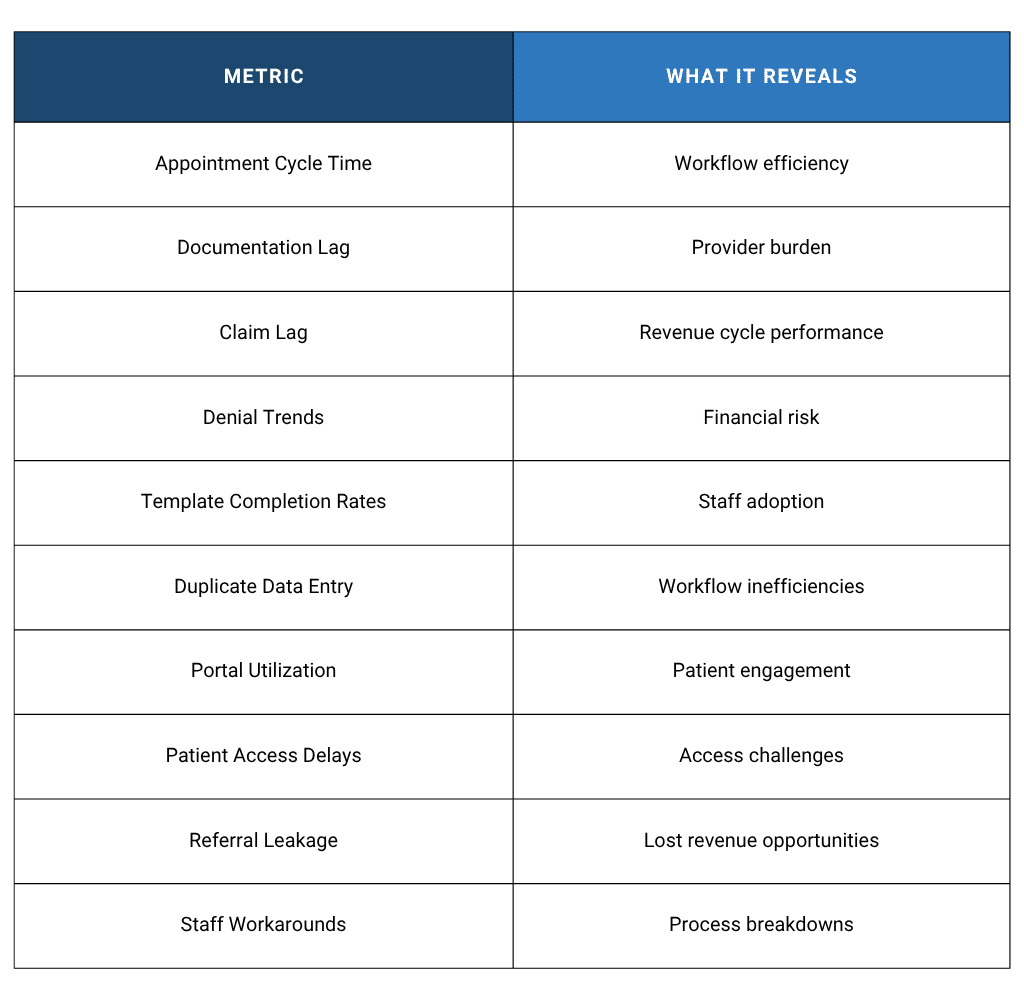
Key metrics include appointment cycle time, documentation lag, claim lag, denial trends, template completion rates, duplicate data entry, patient portal utilization, referral leakage, patient access delays, and staff workarounds.
Reviewing these metrics mid-year helps healthcare leaders identify operational improvement opportunities and prioritize EHR optimization initiatives with the greatest organizational impact.
For ambulatory healthcare leaders, mid-year is one of the most valuable opportunities to evaluate whether technology investments are supporting operational goals. While many organizations review financial performance, staffing metrics, and patient volume trends, fewer take a structured approach to reviewing EHR performance metrics.
That can be a missed opportunity.
An EHR contains far more than clinical documentation. It captures operational data that can reveal workflow inefficiencies, revenue cycle risks, staff adoption challenges, and patient access barriers. When reviewed strategically, EHR performance metrics provide leaders with actionable insights that can improve efficiency, financial performance, and patient experience during the second half of the year.
This article outlines the most important EHR performance metrics ambulatory clinics should review mid-year and explains how leadership teams can use those insights to prioritize improvement initiatives.
Table of Contents
Hide
- 1. Why Is Mid-Year the Right Time to Review EHR Performance?
- 2. What EHR Performance Metrics Reveal Workflow Bottlenecks?
- 3. What EHR Performance Metrics Reveal Revenue Cycle Risk?
- 4. What EHR Performance Metrics Reveal Staff Adoption Problems?
- 5. What EHR Performance Metrics Reveal Patient Access Issues?
- 6. What EHR Performance Metrics Reveal Patient Access Issues?
- 7. From EHR Performance Metrics to Operational Improvement
- 8. When Should Ambulatory Clinics Consider Outside Help?
- 9. Conclusion
- 10. Related Articles
- 11. Further Reading
- 12. Fequently Asked Questions
- 13. Not Sure Where to Start?
Why Is Mid-Year the Right Time to Review EHR Performance?
Mid-year operational reviews provide healthcare leaders with an opportunity to assess progress toward annual goals before year-end pressures begin to accumulate.
Unlike retrospective annual reviews, mid-year assessments create time to make meaningful adjustments. Leaders can identify emerging trends, address performance gaps, and prioritize improvement projects while there is still sufficient time to influence outcomes.
EHR performance reviews also help ensure that technology continues supporting organizational priorities across:
- Clinical operations
- Revenue cycle performance
- Patient access initiatives
- Workforce efficiency goals
- Growth and expansion strategies
Many organizations discover that operational issues have been quietly developing for months before they become visible in leadership dashboards.
Consultant Perspective: Healthcare leaders often discover operational issues hiding within EHR reporting data. Organizations frequently underestimate how small workflow inefficiencies accumulate over time, creating measurable impacts on productivity, revenue, and patient satisfaction.
What EHR Performance Metrics Reveal Workflow Bottlenecks?
Workflow inefficiencies are among the most common operational challenges uncovered during EHR reviews. Several EHR performance metrics can help identify where processes are slowing staff productivity and patient throughput.
Appointment Cycle Time
Appointment cycle time measures the duration from patient arrival to visit completion.
When cycle times increase, clinics may experience:
- Longer patient wait times
- Reduced provider productivity
- Lower patient satisfaction
- Scheduling constraints
Reviewing cycle time trends can help identify bottlenecks occurring during registration, rooming, documentation, or checkout processes.
Documentation Lag
Documentation lag measures the time between patient encounters and completed clinical documentation.
Persistent documentation delays often indicate:
- Provider burden
- Inefficient templates
- Poor workflow design
- Training gaps
Delayed documentation can also create downstream billing delays and reporting challenges.
Duplicate Data Entry
When staff must enter the same information multiple times, productivity declines and data quality suffers.
Duplicate data entry often signals:
- Workflow breakdowns
- Incomplete system integrations
- Inefficient EHR configuration
- Redundant documentation requirements
Staff Workarounds
One of the strongest indicators of workflow problems is staff reliance on manual processes outside the EHR.
Examples include:
- Spreadsheet tracking
- Paper notes
- Manual reminder systems
- External scheduling tools
These workarounds often reveal that system design and operational workflows are not aligned.
Consultant Perspective: One common challenge we see is organizations focusing on user complaints rather than the metrics that validate workflow problems. Data provides a clearer picture of where inefficiencies actually exist.

What EHR Performance Metrics Reveal Revenue Cycle Risk?
Claim Lag
Claim lag measures the time between service delivery and claim submission.
Long claim lag periods can indicate:
- Documentation delays
- Coding inefficiencies
- Workflow bottlenecks
- Staff capacity issues
Even small increases in claim lag can negatively affect cash flow.
Denial Trends
Denial trends help identify recurring issues impacting reimbursement.
Leaders should review:
- Denial frequency
- Denial categories
- Root causes
- Provider-specific patterns
Recurring documentation deficiencies often become visible through denial analysis.
Referral Leakage
Referral leakage occurs when patients leave the organization’s network for services that could potentially be retained internally.
This metric helps identify:
- Lost revenue opportunities
- Coordination challenges
- Scheduling barriers
- Access limitations
Healthcare leaders often discover revenue cycle issues are operational issues first and billing issues second. Improving workflow performance frequently improves financial performance as a result.
What EHR Performance Metrics Reveal Staff Adoption Problems?
Even a well-configured EHR cannot achieve its intended value if staff adoption is inconsistent. Several performance metrics help leaders evaluate whether employees are using the system as designed.
Template Completion Rates
Template completion rates measure consistency in documentation practices.
Low completion rates may indicate:
- Poor template design
- Inadequate training
- User frustration
- Workflow inconsistencies
Utilization of Standardized Workflows
Organizations invest significant effort designing standardized processes. EHR reporting can reveal whether staff are actually following those workflows.
Inconsistent workflow utilization often creates:
- Data quality concerns
- Reporting inaccuracies
- Productivity variation
Documentation Lag by Provider
Comparing documentation lag across providers can help identify training needs and adoption concerns.
Significant variation may suggest:
- Workflow differences
- Documentation burden disparities
- Opportunities for coaching
Staff Workarounds
Workarounds should not simply be viewed as user behavior problems.
They frequently indicate:
- Process design issues
- Technology limitations
- Operational misalignment
Organizations frequently underestimate how staff workarounds create long-term data quality and reporting challenges that affect decision-making throughout the organization.

What EHR Performance Metrics Reveal Patient Access Issues?
Patient access is increasingly becoming a competitive differentiator for ambulatory organizations. Several EHR performance metrics provide valuable insight into access challenges.
Patient Portal Utilization
Portal utilization measures patient engagement and self-service adoption.
Higher portal adoption often supports:
- Improved communication
- Reduced administrative burden
- Better patient engagement
Low utilization may indicate workflow, education, or usability concerns.
Patient Access Delays
Patient access delays measure the time between appointment requests and available appointment slots.
Long delays may indicate:
- Capacity constraints
- Scheduling inefficiencies
- Staffing shortages
- Workflow bottlenecks
Referral Leakage
Referral leakage can also indicate patient access challenges. When patients seek care elsewhere, organizations should investigate whether access barriers contributed to the decision.
Scheduling Efficiency Indicators
Important scheduling metrics include:
- Appointment availability
- Wait times
- No-show patterns
- Provider utilization rates
These indicators provide visibility into both patient experience and operational effectiveness.
Patient access metrics often reveal broader operational constraints that affect both patient satisfaction and organizational revenue performance.
What EHR Performance Metrics Reveal Patient Access Issues?
Not every performance issue requires immediate attention. Leaders should prioritize EHR optimization opportunities based on organizational impact.
Key evaluation criteria include:
- Operational impact
- Financial impact
- Patient access impact
- Staff efficiency impact
- Ease of implementation
Suggested Prioritization Framework
|
Metric Category |
Operational Impact |
Financial Impact |
Priority Level |
|
Workflow Bottlenecks |
High |
Medium |
High |
|
Revenue Cycle Risk |
High |
High |
Highest |
|
Staff Adoption Issues |
Medium |
Medium |
Medium |
|
Patient Access Issues |
High |
High |
High |
Organizations that prioritize improvements based on measurable business impact are more likely to achieve sustainable results.
Healthcare leaders often discover EHR challenges are operational challenges in disguise. Organizations frequently underestimate the relationship between EHR data quality and organizational performance. One common challenge we see is leadership focusing on symptoms rather than the root-cause metrics driving those symptoms.
Successful optimization initiatives begin with understanding what the data is actually revealing.
Key Metrics Dashboard for Mid-Year EHR Review
From EHR Performance Metrics to Operational Improvement
Metrics alone do not improve performance. The true value of EHR reporting comes from translating insights into action.
Successful organizations use mid-year EHR performance reviews to guide:
- EHR optimization initiatives
- Practice management improvements
- Workflow redesign efforts
- Revenue cycle improvement projects
- Healthcare project management priorities
Identifying the right metrics is only the first step. Turning those insights into measurable operational improvements often requires a structured approach that aligns EHR capabilities with clinical workflows, revenue cycle performance, and organizational goals.
Healthcare organizations seeking additional evidence-based guidance can also review the ONC SAFER Guides, which provide nationally recognized best practices for improving the safe and effective use of EHRs.
Learn how our EHR Consulting services help ambulatory organizations optimize performance and maximize the value of their EHR investment.
When Should Ambulatory Clinics Consider Outside Help?
Some organizations can address performance gaps internally. Others may benefit from external expertise.
Warning Signs
Consider additional support when experiencing:
- Persistent documentation lag
- Rising denial rates
- Increasing referral leakage
- Low patient portal utilization
- Staff reliance on workarounds
Common Mistakes
Common leadership mistakes include:
- Focusing only on technical issues
- Ignoring operational metrics
- Reviewing metrics without action plans
- Delaying optimization initiatives
When Expert Guidance May Be Beneficial
Outside expertise may be valuable when:
- Multiple metrics indicate performance decline
- Leadership lacks bandwidth for improvement initiatives
- EHR optimization efforts have stalled
- Operational challenges continue despite system upgrades
In many cases, the issue is not the EHR itself. It is the workflows and processes surrounding it.
Conclusion
Mid-year EHR performance reviews provide healthcare leaders with an opportunity to move beyond assumptions and make decisions based on meaningful operational data.
By evaluating workflow efficiency, revenue cycle performance, staff adoption, and patient access, ambulatory organizations can identify improvement opportunities before they affect year-end performance and better align technology with organizational goals.
The next question isn't whether these metrics matter, it's whether your organization is measuring the right ones and acting on what they reveal.
Evaluate Your EHR's Impact on Organizational Performance
If your organization is experiencing workflow inefficiencies, documentation delays, revenue cycle challenges, or inconsistent EHR reporting, an objective review can help identify the underlying causes and prioritize practical improvement opportunities.
Our Operational & Billing Readiness Review evaluates the operational, workflow, revenue cycle, and EHR-related factors that influence organizational performance, providing leadership with actionable recommendations and a clear path forward.
Schedule an Operational & Billing Discussion
Explore Healthcare Consulting Assessments
Fequently Asked Questions
Most ambulatory organizations should review core EHR performance metrics monthly, with a more comprehensive operational review conducted quarterly and mid-year. Regular reviews help leadership identify trends early and make improvements before performance issues significantly impact operations, finances, or patient experience.

Not Sure Where to Start?
Whether you're preparing to launch a new healthcare organization, addressing compliance concerns, improving operational performance, evaluating technology investments, or looking to strengthen workflows, the right assessment can help identify risks, uncover opportunities, and prioritize next steps.