
Published: 07/08/2026
Share this article

Behavioral health clinics can reduce billing errors and staff rework by standardizing clinical documentation workflows, aligning EHR templates with payer requirements, improving authorization tracking, reducing duplicate data entry, and implementing workflow governance.
Effective behavioral health EHR workflow optimization improves claim accuracy, decreases denials, reduces staff frustration, and creates a more efficient revenue cycle while providing leadership with greater operational visibility.
However, many billing issues originate long before a claim is submitted.
Incomplete intake documentation, inconsistent clinical notes, authorization tracking failures, duplicate data entry, and inefficient EHR workflows frequently create downstream billing errors that lead to staff rework, claim delays, and administrative frustration.
For healthcare leaders, these challenges are not simply technology issues. They affect financial performance, staff satisfaction, compliance, operational efficiency, and leadership visibility into organizational performance.
Understanding how behavioral health EHR workflow optimization influences billing accuracy can help organizations identify root causes, reduce operational waste, and improve revenue cycle outcomes.
In this article, we will explore:
- Why behavioral health EHR workflows break down over time
- Where billing errors typically originate
- The hidden financial cost of workflow inefficiencies
- How workflow optimization reduces staff rework
- Who should own workflow decisions
- What metrics leaders should monitor
- When outside expertise may be beneficial
Table of Contents
Hide
- 1. Why Do Behavioral Health EHR Workflows Break Down Over Time?
- 2. Where Do Behavioral Health Billing Errors Usually Start?
- 3. The Hidden Financial Cost of Workflow Inefficiency
- 4. How Does Behavioral Health EHR Workflow Optimization Reduce Staff Rework?
- 5. How Workflow Inefficiencies Reduce Organizational Capacity
- 6. Who Should Own Workflow Decisions in a Behavioral Health Organization?
- 7. When Workflow Problems Become Revenue Cycle Problems
- 8. What Metrics Should Leaders Track After EHR Workflow Changes?
- 9. Five Questions Leaders Should Ask About Billing-Related Workflow Performance
- 10. Consultant Perspective: What High-Performing Behavioral Health Organizations Do Differently
- 11. When to Consider Outside Help
- 12. Conclusion
- 13. Related Articles
- 14. Further Reading
- 15. Fequently Asked Questions
- 16. Not Sure Where to Start?
Why Do Behavioral Health EHR Workflows Break Down Over Time?
Behavioral health EHR workflows often become inefficient when operational processes evolve faster than the systems supporting them.
Many organizations implement an EHR and establish workflows that function effectively at launch. Over time, however, organizational growth, staffing changes, new payer requirements, and evolving service lines create operational complexity that existing workflows may no longer support.
Common contributors include:
- Growth and service expansion
- Staff turnover and inconsistent training
- New payer requirements
- Workflow workarounds becoming permanent processes
- Lack of periodic workflow reviews
- Limited leadership visibility into workflow performance
As these issues accumulate, organizations often experience increased documentation delays, billing errors, and staff frustration.
Healthcare leaders interested in understanding the broader operational impact of workflow inefficiencies may also find value in reviewing The Hidden Cost of Workflow Inefficiency in Behavioral Health.
Where Do Behavioral Health Billing Errors Usually Start?
Most behavioral health billing errors originate before claims are submitted, often during intake, documentation, authorization management, coding, and charge capture.
When organizations focus solely on denied claims, they often overlook the operational activities that created the denial in the first place.
Intake Workflow Issues
The intake process establishes the foundation for the entire patient journey.
Common intake-related errors include:
- Missing demographic information
- Insurance verification failures
- Incomplete eligibility checks
When patient information is inaccurate at registration, errors frequently follow the patient throughout the billing process.
Documentation Problems
Clinical documentation directly influences coding accuracy and reimbursement.
Common documentation challenges include:
- Missing required clinical elements
- Inconsistent note completion
- Templates that do not align with payer requirements
Even small documentation gaps can create delays, denials, and additional staff rework.
Authorization Tracking Gaps
Authorization management remains one of the most common sources of behavioral health billing challenges.
Common issues include:
- Expired authorizations
- Missed service limits
- Inadequate alerting mechanisms
Without reliable authorization workflows, organizations increase the likelihood of denied services and lost revenue.
Coding and Charge Capture Errors
Billing teams often encounter challenges caused by:
- Service mismatches
- Missed charges
- Incorrect billing codes
These issues frequently require manual corrections that consume valuable staff time.
Leadership Impact
When workflow breakdowns occur upstream, leaders often experience:
- Increased claim denials
- Delayed payments
- Higher rework costs
- Reduced operational visibility
For additional insights into common revenue cycle challenges, organizations may benefit from reviewing Behavioral Health Billing Tips to Overcoming Challenges.

The Hidden Financial Cost of Workflow Inefficiency
Many behavioral health organizations focus on claim denials, reimbursement delays, and accounts receivable performance when evaluating financial challenges. However, the true cost of workflow inefficiency often extends far beyond individual denied claims.
Workflow breakdowns can create revenue leakage throughout the organization. Missing authorizations, delayed documentation, charge capture errors, and incomplete clinical records all contribute to lost revenue opportunities and increased administrative burden.
Common financial consequences include:
Lost Revenue
Workflow failures may result in:
- Preventable claim denials
- Missed billable services
- Authorization-related write-offs
- Delayed claim submission
Even when claims are eventually corrected, reimbursement delays can negatively impact cash flow and financial forecasting.
Increased Labor Costs
Organizations often underestimate the cost of staff rework.
Examples include:
- Correcting documentation deficiencies
- Managing denied claims
- Resubmitting claims
- Investigating authorization issues
These activities consume valuable staff time that could otherwise support patient care or strategic initiatives.
Delayed Cash Flow
Operational inefficiencies frequently increase:
- Days in Accounts Receivable
- Charge lag days
- Billing delays
The result is slower reimbursement and reduced financial visibility.
One common challenge we see is organizations focusing heavily on denial management while overlooking the operational inefficiencies creating those denials in the first place.
Successful organizations address both the symptoms and the root causes.
How Does Behavioral Health EHR Workflow Optimization Reduce Staff Rework?
Workflow optimization eliminates unnecessary steps, reduces duplicate documentation, and improves information flow between departments.
Rather than forcing staff to work around system limitations, optimized workflows help organizations align operational processes with clinical and financial objectives.
Key optimization strategies include:
- Standardized documentation templates
- Automated workflow routing
- Integrated authorization tracking
- Reduced manual data entry
- Improved clinician experience
- Reduced administrative burden
Operational Benefits
Organizations that improve workflow design often experience:
- Faster claim submission
- Lower denial rates
- Improved staff satisfaction
- Reduced overtime
- More accurate reporting
- Better patient throughput
Importantly, workflow optimization should not be viewed solely as an IT initiative. It is an operational improvement strategy that supports clinical, financial, and administrative performance.
Organizations considering larger optimization efforts may also find value in The Perfect Guide to Developing an EHR Optimization Strategy.

How Workflow Inefficiencies Reduce Organizational Capacity
Workflow inefficiencies affect more than billing accuracy and administrative workload. They also reduce an organization's ability to serve patients effectively.
Every hour spent correcting documentation errors, managing authorization issues, responding to billing questions, or reworking denied claims represents time that could have been spent delivering care.
As inefficiencies accumulate, organizations often experience:
- Reduced provider availability
- Fewer patient appointments
- Increased scheduling constraints
- Longer wait times for services
- Delayed patient access
Many organizations initially believe they need additional staff to support growth. In reality, workflow redesign may create significant capacity gains without increasing headcount.
Behavioral health organizations that improve workflow efficiency often discover opportunities to increase throughput, improve patient access, and strengthen financial performance using existing resources more effectively.
From a leadership perspective, workflow optimization should be viewed as both a revenue cycle strategy and a capacity management strategy.
Who Should Own Workflow Decisions in a Behavioral Health Organization?
Successful workflow optimization requires cross-functional ownership involving clinical, operational, financial, and technology leaders.
One of the most common reasons optimization initiatives fail is the assumption that workflow design belongs exclusively to the IT department.
Executive Leadership
Executive leaders should provide:
- Strategic oversight
- Resource allocation
- Organizational accountability
Leadership involvement ensures workflow initiatives remain aligned with organizational goals.
Clinical Leadership
Clinical leaders play a critical role in:
- Establishing documentation standards
- Supporting adoption efforts
- Ensuring clinical workflows remain practical and compliant
Revenue Cycle Team
Revenue cycle leaders contribute expertise related to:
- Billing accuracy
- Denial management
- Claims performance
Their involvement helps connect operational changes to financial outcomes.
IT and EHR Teams
Technology teams support:
- Configuration management
- Workflow automation
- System enhancements
However, technology should support workflows rather than define them.
Governance Framework
Organizations that sustain workflow improvements typically establish:
- Workflow review committees
- Change management processes
- Continuous improvement models
Governance creates accountability and prevents temporary workarounds from becoming permanent operational barriers.

When Workflow Problems Become Revenue Cycle Problems
Many healthcare organizations view billing problems as revenue cycle issues when the root cause actually resides within operational workflows and EHR design.
The relationship between workflow inefficiencies and financial performance is often direct.
Examples include:
- Delayed documentation leading to delayed billing
- Authorization failures creating denials
- Charge capture gaps reducing revenue
- Staff rework increasing operating costs
From a leadership perspective, declining revenue cycle performance should prompt organizations to evaluate upstream operational workflows before assuming the billing department is solely responsible.
Organizations exploring broader workflow improvement initiatives may find useful guidance in EHR Project Management: Reducing Pain with Strong Techniques.
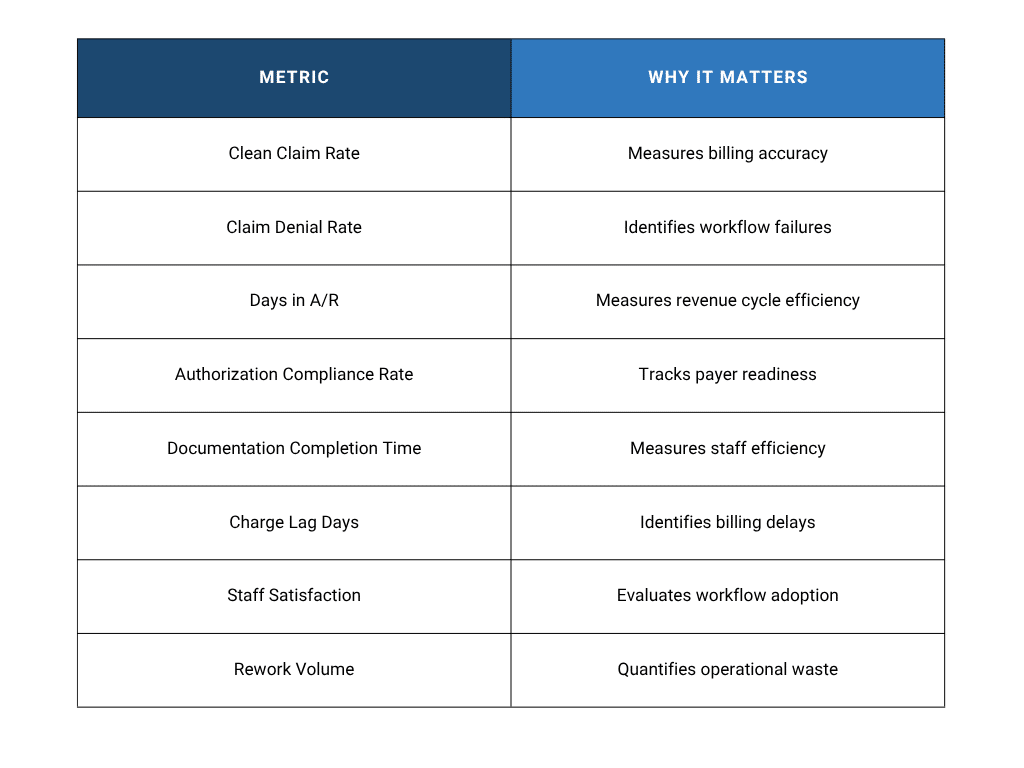
What Metrics Should Leaders Track After EHR Workflow Changes?
Organizations should measure both operational and financial outcomes following workflow improvements.
Tracking meaningful performance indicators allows leadership teams to determine whether workflow changes are producing measurable value.
Leadership Takeaway
Successful behavioral health EHR workflow optimization should be measured using business outcomes, not simply system utilization metrics.
Organizations that focus exclusively on EHR usage statistics often miss the operational and financial impact of workflow improvements.
Five Questions Leaders Should Ask About Billing-Related Workflow Performance
Behavioral health leaders should periodically evaluate whether operational workflows are supporting both clinical and financial objectives.
Consider the following questions:
1. Are claim denials increasing?
Increasing denials often indicate workflow issues occurring long before claims are submitted.
2. Are staff performing repetitive corrections?
Frequent documentation updates, authorization corrections, and claim rework may signal underlying workflow inefficiencies.
3. Are authorizations frequently missed or delayed?
Authorization failures often represent process breakdowns rather than payer-related issues.
4. Is documentation completion delayed?
Late documentation frequently contributes to billing delays, staff frustration, and reduced visibility into performance.
5. Can workflow problems be measured objectively?
Organizations that rely primarily on anecdotal feedback often struggle to identify root causes and prioritize improvements.
Consultant Perspective: What High-Performing Behavioral Health Organizations Do Differently
Across behavioral health organizations, several patterns consistently emerge.
Observation #1: They Evaluate Workflows Before Blaming Billing Departments
High-performing organizations recognize that many billing issues originate upstream in documentation, intake, authorization management, and charge capture processes.
Observation #2: They Monitor Leading Indicators Rather Than Waiting for Denials
Rather than focusing solely on denial rates, they monitor workflow metrics that identify potential problems before claims are submitted.
Observation #3: They Establish Ownership for Authorization Management
Successful organizations assign clear accountability for authorization tracking, monitoring, and renewal processes.
Observation #4: They Measure Operational and Financial Outcomes Together
Workflow improvements are evaluated using both operational metrics and revenue cycle performance indicators.
Observation #5: They Continuously Improve Rather Than Rely Solely on Training
Training is important, but sustainable improvement typically requires workflow redesign, governance, accountability, and ongoing optimization efforts.
Organizations that consistently improve billing accuracy and financial performance rarely view workflow optimization as a one-time project. They treat it as an ongoing operational discipline.
When to Consider Outside Help
Warning Signs
Organizations may benefit from additional support when they experience:
- Persistent claim denials
- Increasing staff overtime
- Frequent documentation corrections
- Delayed billing cycles
- Staff complaints regarding EHR usability
- Lack of workflow ownership
Common Mistakes
Common pitfalls include:
- Assuming the EHR system itself is the problem
- Making configuration changes without evaluating workflows
- Ignoring front-end operational processes
- Failing to measure outcomes
When Expert Guidance May Be Beneficial
Outside expertise may be helpful during:
- Rapid organizational growth
- EHR implementation or optimization projects
- Revenue cycle performance declines
- Workflow redesign initiatives
- Behavioral health compliance concerns
A structured EHR consulting engagement can help organizations evaluate workflow design, governance, operational performance, and opportunities for sustainable improvement.
Conclusion
Workflow inefficiencies often create billing errors long before claims reach the revenue cycle team. Problems related to intake, documentation, authorization management, coding, and charge capture can generate significant rework, increase denials, reduce organizational capacity, and negatively affect financial performance.
Behavioral health EHR workflow optimization should be viewed as an operational, financial, and leadership initiative rather than a technology project alone. Organizations that establish governance, accountability, workflow ownership, and meaningful performance measurement are better positioned to reduce rework, improve billing accuracy, strengthen staff satisfaction, and support sustainable growth.
The behavioral health organizations that achieve the strongest revenue cycle performance rarely focus exclusively on billing operations. They recognize that documentation quality, authorization management, workflow design, governance, and operational accountability all influence financial outcomes.
By addressing workflow challenges before they become billing problems, organizations can reduce operational waste, improve reimbursement accuracy, strengthen patient access, and create a more scalable foundation for long-term success.
Fequently Asked Questions
Behavioral health clinics should conduct formal workflow reviews at least annually and whenever significant operational changes occur. Examples include new payer contracts, service expansions, staffing changes, or EHR upgrades. Regular reviews help identify workflow breakdowns before they impact billing performance or staff productivity.

Not Sure Where to Start?
Whether you're preparing to launch a new healthcare organization, addressing compliance concerns, improving operational performance, evaluating technology investments, or looking to strengthen workflows, the right assessment can help identify risks, uncover opportunities, and prioritize next steps.